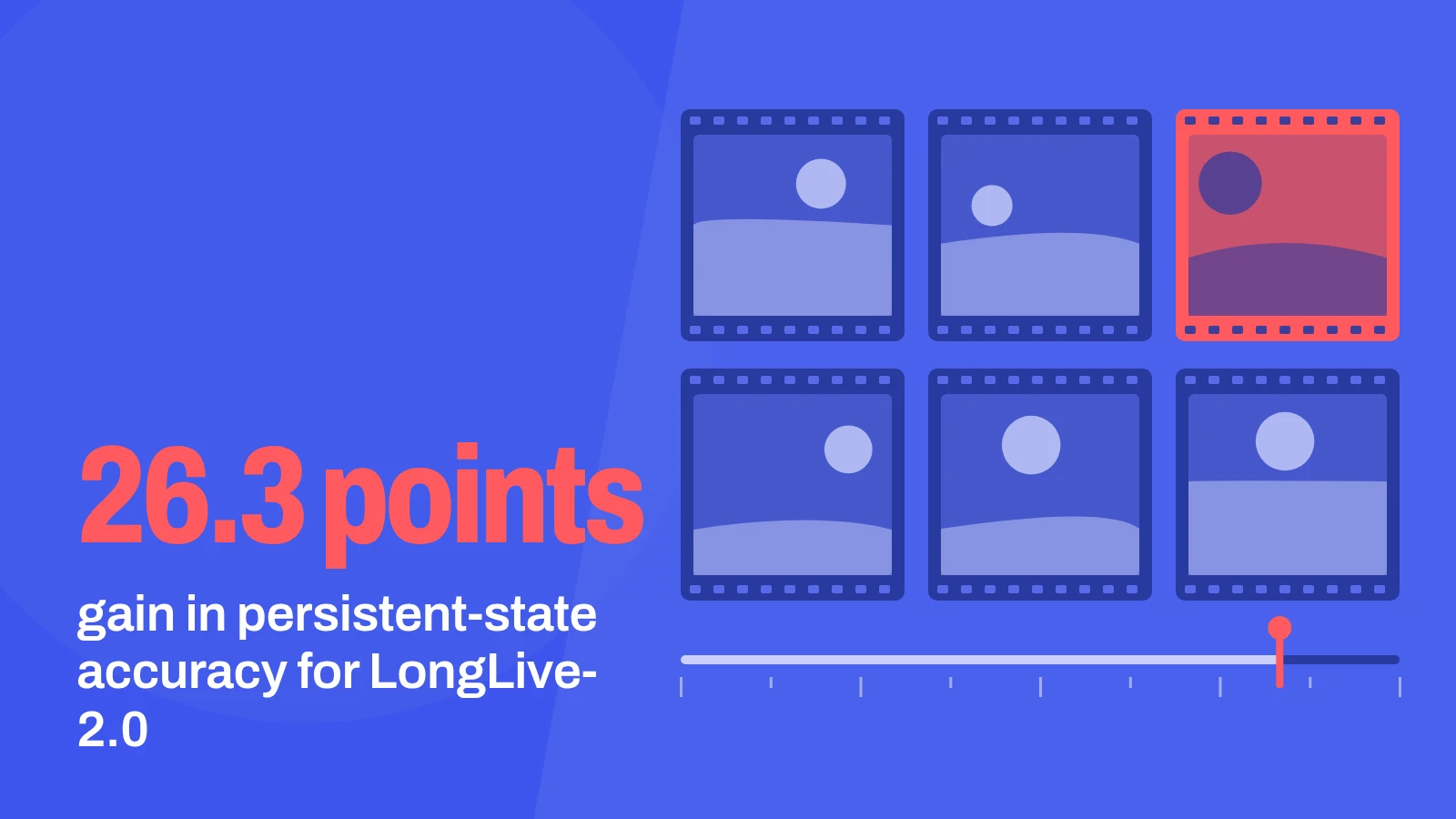
On the LongStory-Online benchmark, a memory agent added to LongLive-2.0 lifts its persistent-state accuracy by 26.3 points, the identity of the protagonist by 44.9 and consistency of revisited places by 40.4, while adding roughly 1% to generation time on H100 (arXiv). For anyone producing multi-shot stories with LongLive-2.0, the pitch is that characters and places stop drifting between shots without a slower generator, though the agent needs GPUs of its own (arXiv).
A memory agent that never sees the video
Agentic LongLive is built as an asynchronous memory for long video generation. A memory agent runs on separate GPUs and reads only the prompts revealed so far, never the generated video. For every person, object and scene it keeps a text state plus evolving images. The paper says the agent builds each shot’s memory ahead of the prompt on its own GPUs, which is why the video does not wait and the overhead is about 0.9% on H100, while reading only prompts keeps video errors from being written back (nvlabs.github.io).
The project’s release entry dated 2026-11-24 describes it as an asynchronous LLM memory agent for real-time long video generation. The same entry lists the full system on two generators, LongLive-2.0 and MiniMax-H3, plus a benchmark, robot-video memory and reinforcement-learning training of the memory planner.
November entries against the repository’s earlier releases
In the table below, each row gives “Date”, “Entry, as written by the project”, “Source page”.
| Date | Entry, as written by the project | Read on |
|---|---|---|
| 2026-11-25 | The Agentic LongLive paper is available on arXiv and Hugging Face Papers. | 2026-11-28 |
| 2026-11-24 | We release Agentic LongLive: an asynchronous LLM memory agent for real-time long video generation, with the full system on LongLive-2.0 and MiniMax-H3 generators, the LongStory-Online benchmark, robot-video memory and RL training of the memory planner. → Agentic-LongLive/ · Project page |
2026-11-28 |
| 2026-10-08 | The Long-WAM paper is available on arXiv. | 2026-11-28 |
| 2026-10-07 | We release Long-WAM: long-context world-action models, robot-video pretraining, benchmark training/evaluation and real-robot deployment demos. → Long-WAM/ · Project page |
2026-11-28 |
| 2026-09-28 | We release LongLive-Plug training and inference code with four recipes covering CFG and few-step distillation. → LongLive-Plug/ |
2026-11-28 |
| 2026-07-08 | LongLive 2.0 supports FP8 inference. Please refer to here. | 2026-11-28 |
| 2026-06-01 | We released LongLive-RAG, a general retrieval-augmented framework for long video gen. | 2026-11-28 |
| 2026-05-30 | LongLive 2.0 now supports I2V AR teacher-forcing training and I2V DMD distillation for Wan2.2-TI2V-5B. | 2026-11-28 |
The paper entry followed a day later, on 2026-11-25. Earlier entries show the repository moving from generator features toward memory and robotics: LongLive-RAG, a retrieval-augmented framework, came on 2026-06-01, and FP8 inference for LongLive 2.0 on 2026-07-08. LongLive-Plug, with four recipes covering CFG and few-step distillation, followed on 2026-09-28, and Long-WAM on 2026-10-07. Read in order, the entries show LongLive-RAG, a retrieval-augmented framework, on 2026-06-01, then FP8 inference, LongLive-Plug and Long-WAM, and then Agentic LongLive on 2026-11-24 (GitHub). It also builds on the base generator that already received FP8 inference support in July.
Revisit consistency from 15.0% to 55.4%
The paper compares the full system against the built-in memory of LongLive-2.0 with the same generator and prompts, so the comparison isolates memory. In that comparison, state accuracy rises by 26.3 points, and revisit consistency goes from 15.0% to 55.4%. In a human study, the full system took a 98.8% best-version vote share for persistent state against LongLive-2.0’s built-in memory. The vote share and the benchmark metrics measure different things, but they point the same way for the persistent-state criterion.
The overhead figure comes from the paper, which gives about 1% extra generation time on H100. The project page reports frame rates on a different card: with the agent, FastH3-Omni, LongLive-H3 and LongLive-2.0 run at 29.0, 34.7 and 34.3 FPS on B200s, for 24 FPS video.
Extra GPUs, and per-shot quality left to the base model
The authors state that memory needs extra GPUs for the agent ranks and the prefill worker.
For the two real-time systems, the project page lets viewers open the agent behind each video and watch what it did while the story played. A team choosing between its current LongLive-2.0 setup and the agent version should budget separate GPUs for the agent and check revisit consistency on its own stories, since the baseline figure of 15.0% shows how much the built-in memory loses when a place returns.
Related coverage: ScoutCache, a training-free method, reports up to 2.28× speedup on Self-Forcing.
Follow and ask
Add to Preferred Sources on Google
Summarise with AI:ChatGPTClaudePerplexityGoogle AI
How we built this
Release historyDated release entries published by the project
Dated entries read by our code from the project's own release notes, news list or changelog, newest first, with the page each was read from; the entry text is the project's own wording, not a check of what it says. Each entry is shown whole. A link in an entry is shown as its text; the source page has it. Rows: the newest 8 of 15.
Sources
The sources this article was written from. Links open the original page.
- arXivAgentic LongLive: Asynchronous Agentic Memory for Long Video Generationarxiv.org
- arXivAgentic LongLive: Asynchronous Agentic Memory for Long Video Generationarxiv.org
- GitHubhttps://github.com/NVlabs/LongLive: page linked by the paper as its resourceraw.githubusercontent.com
- nvlabs.github.iohttps://nvlabs.github.io/LongLive/Agentic-LongLive/: page linked by the paper as its resourcenvlabs.github.io