In the ProxyGenBench paper on arXiv, adding a proxy raised action-transition accuracy from 0.894 to 1.000 and cross-shot spatial consistency from 0.833 to 0.952 on matched subsets (arXiv). The same paper reports that more detailed proxies raised Preserve while lowering Complete across all five models tested. For anyone feeding rough 3D layouts to a video model, the result suggests that a fuller proxy is not automatically the better input.
312 cases, five generators, three metrics
ProxyGenBench contains 312 evaluation cases drawn from 60 scenes across three scene tasks (arXiv). The cases vary proxy fidelity, text detail and multimodal inputs in a controlled way. Five video generators are scored with verified checklists written for each case. The paper’s three metrics are Preserve, Complete and Bind, and Average is their mean.
The authors checked their automatic judge against people: of 3,199 criterion-level judgments, checklist validity was 99.9% and overall scoring accuracy against human annotations reached 92.9%. All figures here are the authors’ own; the action-transition and cross-shot scores were produced by Qwen3.5-397B-A17B, and MEt3R is a separate geometric metric rather than the validated judge.
Proxy against no proxy: 35 of 50 pairs preferred
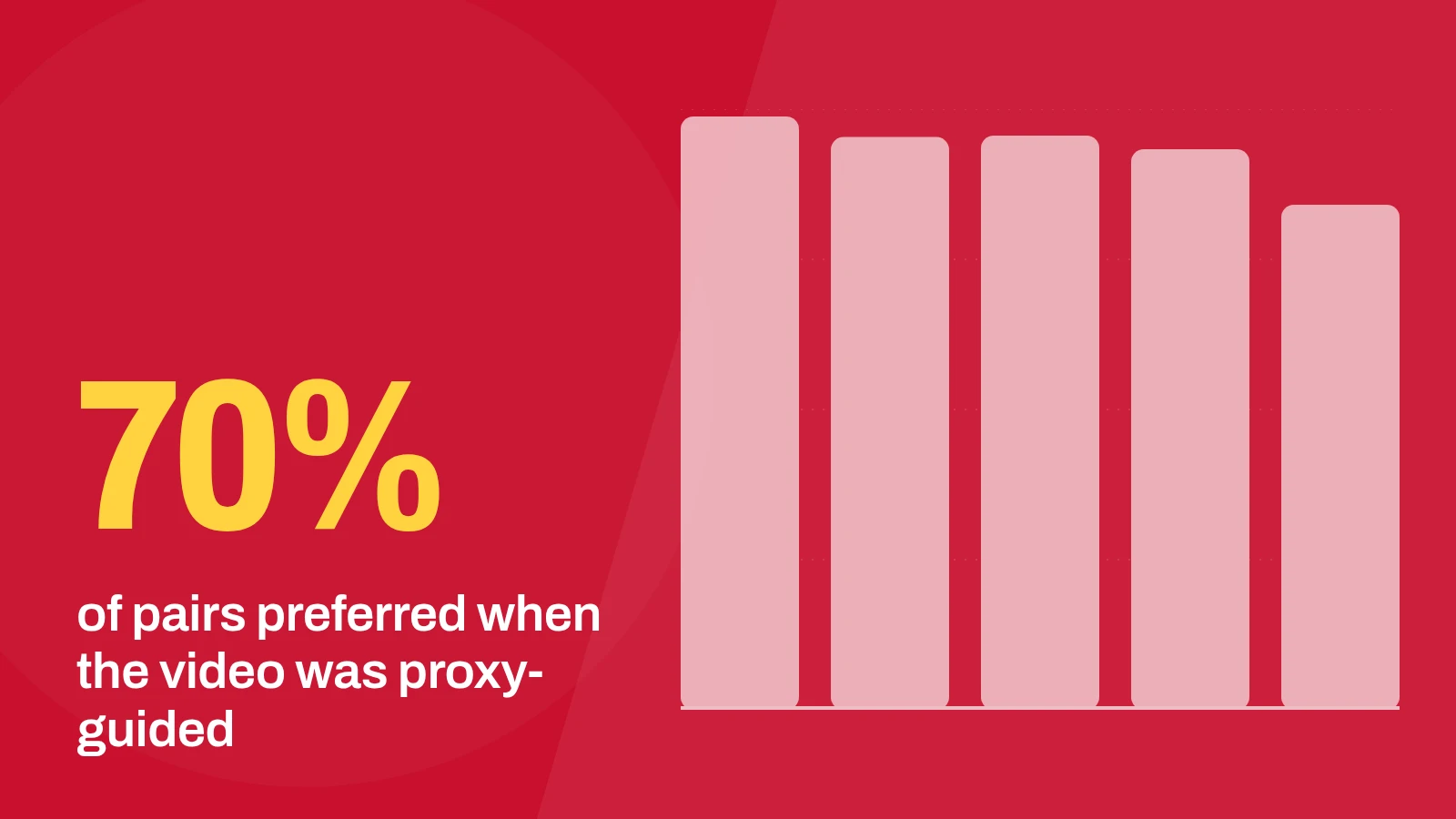
On matched subsets, adding a proxy also lowered MEt3R error from 0.464 to 0.337, alongside the gains in action-transition accuracy and cross-shot consistency. Under the two-order VLM protocol, proxy-guided outputs were preferred in 35 of 50 pairs (70%). The gains are largest on structure: transitions between actions and consistency across shots are what a proxy pins down.
Pr0 starting scores and the Preserve–Complete split
In the table below, each row gives “Model”, “Pr0 – Blockout: P”, “Pr0 – Blockout: C”, “Pr0 – Blockout: B”, “Pr0 – Blockout: Average”, “Source page”.
| Model | Pr0 – Blockout: P | Pr0 – Blockout: C | Pr0 – Blockout: B | Pr0 – Blockout: Average |
|---|---|---|---|---|
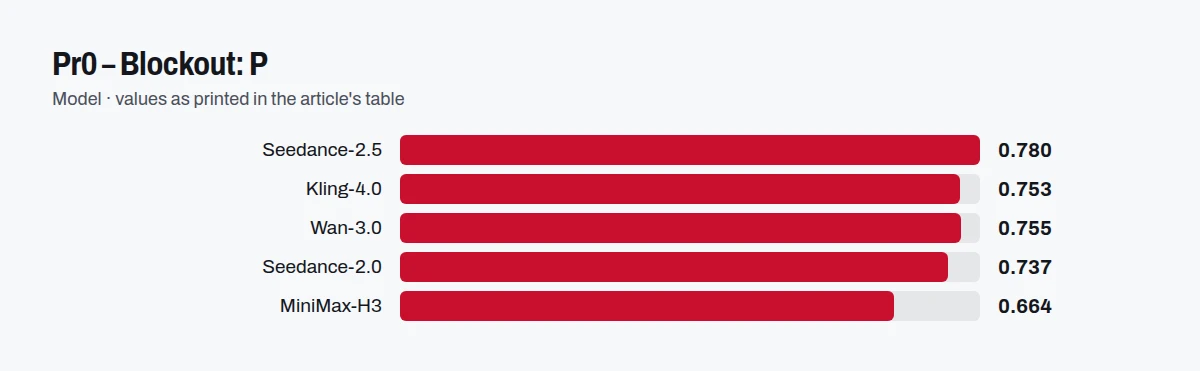
| Seedance-2.5 | 0.780 | 0.598 | 0.754 | 0.711 |
| Kling-4.0 | 0.753 | 0.647 | 0.730 | 0.710 |
| Wan-3.0 | 0.755 | 0.587 | 0.681 | 0.675 |
| Seedance-2.0 | 0.737 | 0.560 | 0.738 | 0.678 |
| MiniMax-H3 | 0.664 | 0.612 | 0.843 | 0.706 |
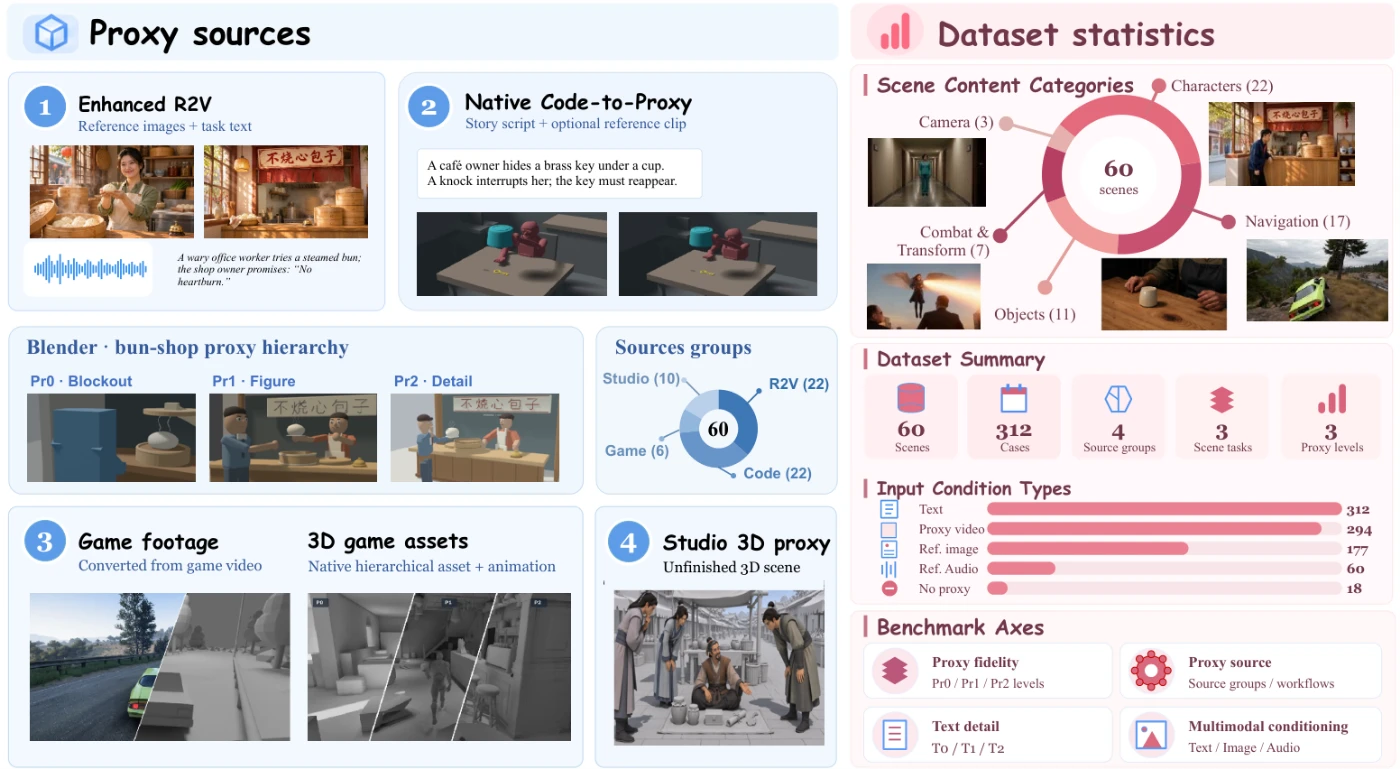
On the 31 shared T2 scenes without independent audio references, Preserve rises by 1.1–6.7 percentage points from Pr0 to Pr2 for all five models, while Complete falls by 4.8–7.9 points. Seedance-2.5 gains 2.1 points in Preserve and loses 6.0 in Complete; Kling-4.0 gains 2.9 and loses 7.2. Seedance-2.5 keeps an Average of 0.711 while its Bind improves from 0.754 to 0.794, whereas the Average of Kling-4.0 drops from 0.710 to 0.689. For the other four models, Pr0 gives the highest Average.
The Pr0 (Blockout) rows show where each model starts: Seedance-2.5 has a Complete of 0.598 against 0.647 for Kling-4.0, so the model with the better Preserve score of 0.780 is weaker at finishing the scene. MiniMax-H3 has the lowest Preserve at Pr0, 0.664, but the highest Bind, 0.843, which shows that the three metrics do not move together. Wan-3.0 and Seedance-2.0 sit close together on Average at Pr0, 0.675 and 0.678, though Seedance-2.0 has the higher Bind, 0.738 against 0.681.
Studio 3D: structure preserved, conditions rarely bound
On the 12 Studio 3D proxy cases evaluated across all five models, Preserve spans 0.848 to 0.962, while Bind stays between 0.182 and 0.500. Seedance-2.5 and Kling-4.0 each score B=0.318 there, below MiniMax-H3 at B=0.500, and Seedance-2.0 reaches P=0.962 with only B=0.182. The paper reads these results as showing that binding conditions is not a by-product of structural control, since models must ground extra information inside the structure they preserve. Set beside the 312-case design of the benchmark, a 12-case subset is small, so those Bind figures describe one slice rather than the whole benchmark.
Declared limits and a release still pending
The authors note that their fidelity levels vary geometric and motion detail together, so the effects cannot be separated. They add that subtle physical interactions and precise audiovisual synchronization remain hard for current VLM-based evaluators. The paper describes 312 cases, while the project page says public release will follow completion of the review, so outside teams cannot yet rerun the cases it describes (2kxx.github.io).
For a team choosing between a rough and a detailed proxy, the Pr0 to Pr2 numbers argue for testing both: Pr0 gave the highest Average for four of the five models, and only Seedance-2.5 held its Average as detail grew.
Not in the sources: hardware requirements
We check six facts on every story in the full text of each source. The pages listed under Sources do not state hardware requirements.
Related coverage: SciWorldBench: video models score 1.4% to 24.8% on paired science experiments.
Follow and ask
Add to Preferred Sources on Google
Summarise with AI:ChatGPTClaudePerplexityGoogle AI
Where to try it
From the sources: 2kxx.github.io/ProxyGenBench and Licence of the repository 2kxx/ProxyGenBench on GitHub: none.
Abracadabrax lists Seedance 2.5 and Seedance 2.5 Reference among its video models. Seedance 2.5 on Abracadabrax
Abracadabrax has a $1 trial for 7 days; it then renews monthly on the plan you pick, from $34 a month, until you cancel.
How we built this
Published resultsTable 4 of the paper: Results across three proxy-fidelity levels
Rows of Table 4 of the paper (arXiv HTML version), copied cell for cell by our code; a two-row header is shown as "group: column"; an empty name cell repeats the name above it. These are the authors' own figures, not an independent test. The table has 13 columns; 5 shown. Not shown: Pr1 – Figure (4 columns), Pr2 – Detail (4 columns).
Sources
The sources this article was written from. Links open the original page.
- arXivProxyGenBench: Benchmarking Proxy-Guided Video Generationarxiv.org
- arXivProxyGenBench: Benchmarking Proxy-Guided Video Generationarxiv.org
- 2kxx.github.iohttps://2kxx.github.io/ProxyGenBench/: page linked by the paper as its resource2kxx.github.io
- GitHubLicence of the repository 2kxx/ProxyGenBench on GitHub: noneapi.github.com
- AbracadabraxAbracadabrax: Seedanceabracadabrax.app