On minute-long round trips across four datasets, Lyris reduces camera error by 3.8x and improves consistency upon return by 22% on average versus state-of-the-art methods, according to its authors (arXiv). They also describe walkthroughs longer than three minutes and 50 meters generated from one photo, moving through doorways into rooms the input never shows. For anyone who needs a generated camera path to match a requested trajectory, the rotation-error gap to the baselines is the figure to watch.
A planner that renders the layout before each chunk
Lyris builds long videos chunk by chunk, with a planner that decides what lies ahead and a persistent scene memory that later chunks draw on (arXiv). According to the paper, the memory starts as a point cloud reconstructed from the input views, and each chunk can retrieve frames from a bank as appearance references. At test time it retrieves three appearance references per chunk and samples with eight steps and no guidance.
The generator is MiniMax-H3 Ref2VA, fine-tuned with a rank-32 LoRA applied to attention and feed-forward layers, on clips of 124 frames at 832× 480. The authors found that rendering the layout matters: stating it only in the prompt, as a natural-language description of each chunk, gives a 2.8× higher rotation error. That ablation suggests the rendered layout, not the planner’s text, carries most of the camera control.
Against five baselines on ScanNet++ round trips
In the table below, each row gives “Method”, “ScanNet++: RotErr ↓”, “ScanNet++: TransErr ↓”, “ScanNet++: PSNR ↑”, “ScanNet++: SSIM ↑”, “CA-1M: RotErr ↓”, “Source page”.
| Method | ScanNet++: RotErr ↓ | ScanNet++: TransErr ↓ | ScanNet++: PSNR ↑ | ScanNet++: SSIM ↑ | CA-1M: RotErr ↓ |
|---|---|---|---|---|---|
| AnyRecon | 31.2 | 0.37 | 15.17 | 0.648 | 45.9 |
| GEN3C | 15.3 | 0.25 | 17.14 | 0.721 | 27.9 |
| Lyra2 | 14.1 | 0.29 | 15.56 | 0.671 | 25.7 |
| SolarWM-H3 | 9.7 | 0.29 | 14.44 | 0.630 | 9.0 |
| Spatia | 54.5 | 0.69 | 12.69 | 0.566 | 60.3 |
| WorldCrafter | 16.3 | 0.33 | 13.47 | 0.615 | 24.8 |
| Lyris | 1.5 | 0.05 | 19.98 | 0.758 | 4.7 |
| Lyris w/ full path | 1.4 | 0.04 | 20.04 | 0.761 | 1.9 |
| GEN3C | 4.2 | 0.57 | 13.47 | 0.448 | 15.8 |
| Lyris w/ full path | 1.0 | 0.08 | 15.49 | 0.481 | 2.6 |
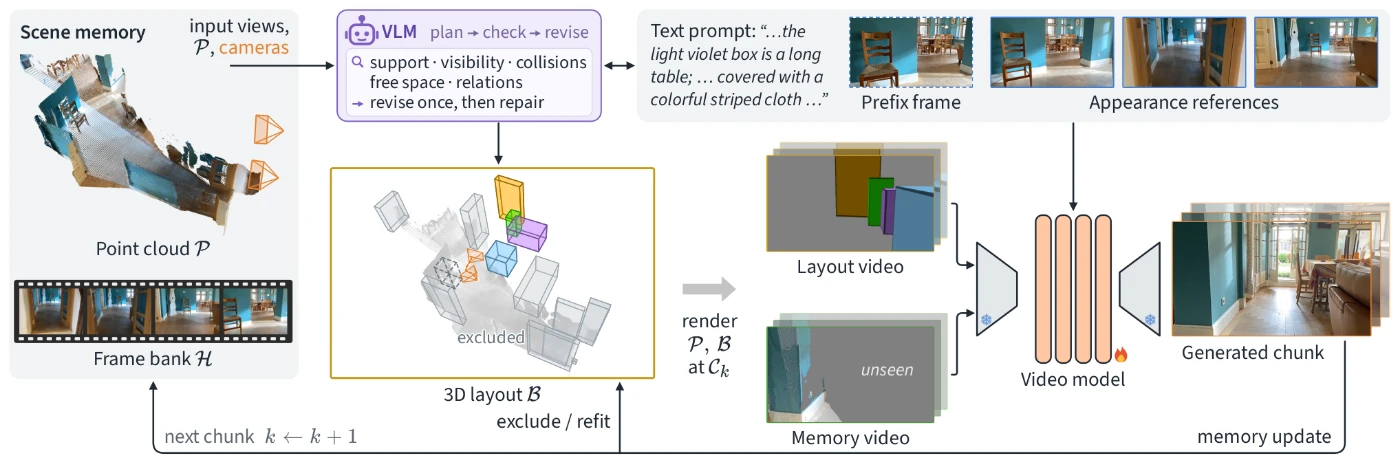
In the autonomous-exploration setting, every method receives only the start frame, its caption and the cameras, and the paper says Lyris outperforms all baselines on every metric on all four datasets.
On the ScanNet++ columns, Lyris posts a rotation error of 1.5, against 9.7 for SolarWM-H3, the closest baseline on that measure. Image quality moves in the same direction: Lyris reaches a PSNR of 19.98 where GEN3C, the best baseline on that column, has 17.14.
Geometry quality and sampling cost bound the claims
The authors state that the method depends on the quality of the estimated geometry, because depth and alignment mistakes can build up in the memory and affect later chunks. They also say the model still needs multiple steps of diffusion sampling and is not yet interactive.
The headline averages cover round trips, where the camera returns to a place the memory already holds, so the 22% consistency gain on return says little about paths that never revisit a spot. The full-path gains also depend on having the whole camera path before generation.
A smaller 8B backbone and extra input photos
Although the main experiments start from one photo, Lyris accepts multiple posed views, and giving it five views along the path lifts PSNR by 2.5 to 3.8 dB over a single view on every dataset. Even when all five views fall within the first 40% of the path, PSNR over the remaining 60% rises by more than 2 dB.
Not in the sources: price
We check six facts on every story in the full text of each source. The pages listed under Sources do not state a price.
Related coverage: One Shot Any View reshoots clips on new camera paths; authors report lower pose error than two baselines.
Follow and ask
Add to Preferred Sources on Google
Summarise with AI:ChatGPTClaudePerplexityGoogle AI
How we built this
Published resultsTable 2 of the paper: Autonomous exploration
Rows of Table 2 of the paper (arXiv HTML version), copied cell for cell by our code; a two-row header is shown as "group: column"; an empty name cell repeats the name above it. These are the authors' own figures, not an independent test. The table has 15 columns; 6 shown, with every column that holds a figure this article gives or a measure it names. Not shown: ScanNet++: 3 more columns, CA-1M: 6 more columns. Rows: 10 of 16, with every row whose value this article gives, or that it names; not shown: rows 9, 11, 12, 13, 14, 15.
Sources
The sources this article was written from. Links open the original page.