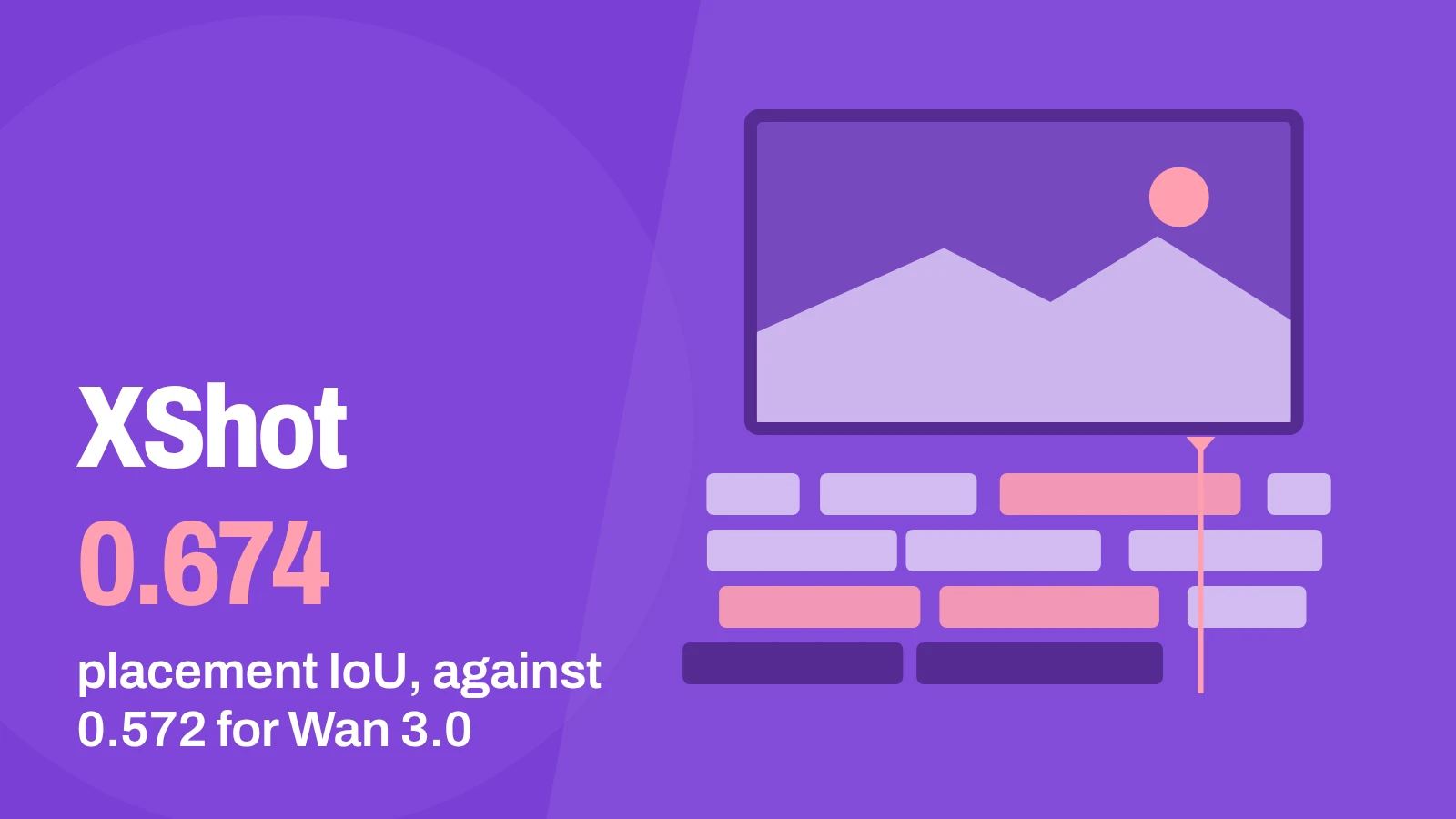
The XShot paper, on cross-shot video object insertion, claims that its method positions inserted objects with more precision and draws them with greater fidelity than both open-source and commercial video editors, and that the remainder of the shot stays untouched (arXiv). On the paper’s benchmark, XShot reaches a placement IoU of 0.674, while Wan 3.0, the strongest baseline, reaches 0.572, and XShot also records the lowest center error (arXiv). For an editor who has a second angle of the same scene, the input needed is a reference clip rather than hand-drawn masks or camera data.
A reference shot replaces masks, boxes and poses
XShot adds objects to a target shot by watching another shot of the same scene. The reference video need not be aligned with the target, and the method needs no mask, box or camera pose. Placement is guided by a geometry-aware cross-shot attention. According to the paper, this attention derives the epipolar geometry linking the two shots from the model’s own correspondences, then uses it to steer where the target looks in the reference and the exemplars.
Users do not have to supply camera poses, because the model estimates the geometry on its own from correspondences between the clips, but it still needs a few exemplar images of the object in addition to the two shots.
Placement, fidelity and price against Wan 3.0 and the other editors
The authors report that XShot puts objects nearest to their true location: its IoU is 0.674, and Wan 3.0, the strongest baseline, scores 0.572. The full model also has the lowest center error on the same benchmark. The paper adds a user study in which 21 participants voted on clips sampled from the benchmark.
Among the commercial baselines, the paper lists MiniMax-H3 at $0.06 per second of output. The IoU gap is the figure to weigh if the task is putting an object at the right spot and scale in a second shot, since that is what the metric measures.
Ablation: what each component of XShot is worth
In the table below, each row gives “Variant”, “Variant”, “Variant”, “Placement: IoU ↑”, “Placement: Cen. ↓”, “Object fidelity: LPIPS ↓”, “Source page”.
| Variant | Variant | Variant | Placement: IoU ↑ | Placement: Cen. ↓ | Object fidelity: LPIPS ↓ |
|---|---|---|---|---|---|
| w/o geometry-aware attention | w/o geometry-aware attention | w/o geometry-aware attention | 0.570 | 0.0276 | 0.170 |
| Number of exemplars | { | 5 | 0.664 | 0.0272 | 0.133 |
| Number of exemplars | { | 3 | 0.660 | 0.0259 | 0.135 |
| Number of exemplars | { | 1 | 0.621 | 0.0261 | 0.152 |
| Number of exemplars | { | 0 | 0.552 | 0.0242 | 0.204 |
| 3D views instead of exemplars | 3D views instead of exemplars | 3D views instead of exemplars | 0.547 | 0.0270 | 0.203 |
| Full Model | Full Model | Full Model | 0.674 | 0.0237 | 0.132 |
In the paper’s ablation, the full model is best on every metric. Taking out the geometry-aware attention drops IoU from 0.674 to 0.570 and pushes LPIPS up from 0.132 to 0.170. The authors explain that without epipolar geometry the model must infer from appearance alone where a point of the reference lands in the target, which can put an object at a wrong place or scale.
The exemplar count shows a steady climb: IoU is 0.552 with no exemplars, 0.621 with 1, 0.660 with 3 and 0.664 with 5, against 0.674 for the full model. Most of the gain arrives by the third exemplar, and the step from 3 to 5 is small. Replacing exemplars with 3D views gives an IoU of 0.547, below the variant with no exemplars at 0.552. Center error is lowest for the full model at 0.0237, and the variant with no exemplars follows at 0.0242.
Small fast-moving objects lose their shape
The authors list limitations, and the first is that small objects in fast motion lose their shape. The benchmark results come from the paper’s own test set and user study, so a clip with a small, quickly moving object is the case to check before relying on the method.
Pooled references cut generation time
XShot pools the reference to save compute. Compared with using the full reference, the pooled version generates a clip 1.30 times faster at 33 reference frames and 2.25 times faster at 129 frames. For someone running the model, the saving grows with the length of the reference clip, so long references are where pooling matters most.
Related coverage: VideoEditor-MoE: authors report 0.853 edit execution rate for 56B model.
Follow and ask
Add to Preferred Sources on Google
Summarise with AI:ChatGPTClaudePerplexityGoogle AI
Where to try it
Abracadabrax lists Wan 3.0 among its video models. Wan 3.0 on Abracadabrax
Abracadabrax has a $1 trial for 7 days; it then renews monthly on the plan you pick, from $34 a month, until you cancel.
How we built this
Published resultsTable 3 of the paper: Ablation on the benchmark, with the metrics of Tab. 1
Rows of Table 3 of the paper (arXiv HTML version), copied cell for cell by our code; a two-row header is shown as "group: column"; an empty name cell repeats the name above it. These are the authors' own figures, not an independent test. The table has 11 columns; 6 shown, with every column that holds a figure this article gives or a measure it names. Not shown: Object fidelity: 2 more columns, Whole video (3 columns).
Sources
The sources this article was written from. Links open the original page.
- arXivXShot: Cross-Shot Video Object Insertion from a Reference Videoarxiv.org
- arXivXShot: Cross-Shot Video Object Insertion from a Reference Videoarxiv.org
- AbracadabraxAbracadabrax: Wanabracadabrax.app