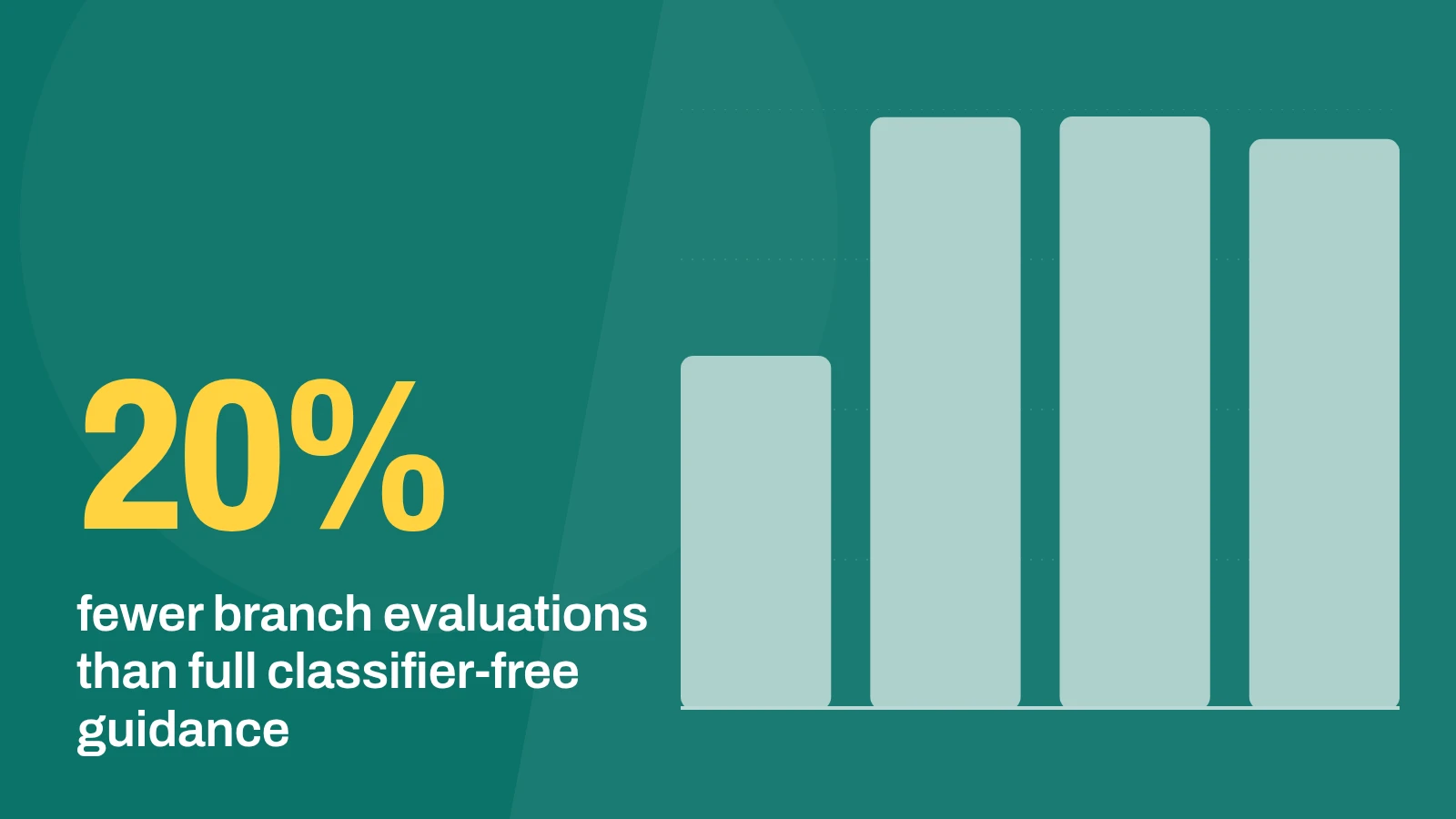
On CogVideoX-2B, the BATMoS guidance scheduler gets the highest VBench total among eight allocation policies and comes within 0.10 points of full classifier-free guidance while using 20% fewer branch evaluations, according to its arXiv paper (arXiv). For someone paying for sampling time on that model, the paper’s affine time model puts full CFG at 86.0 seconds and BATMoS at 71.4 seconds (arXiv).
A router that chooses between fresh and cached guidance
BATMoS, short for Budget Aware Temporal Mixture of Strategies, routes between fresh classifier-free guidance and cached guidance, and it does so with a single pretrained denoiser. According to the authors, the resulting schedule needs no additional router training and no per-budget threshold search. The paper says the same fixed block ranking supplies the schedule at every budget, so a single integer picks how many blocks use cached guidance, with no per-budget threshold search or router training.
The experiments use CogVideoX-2B at 480× 720 resolution with 49 frames and guidance scale s=6. Every number below therefore describes that one model and that one setting, not the CogVideoX family or other video backbones.
Highest total among eight policies, near full CFG
The evaluation covers 4,720 videos per configuration across all sixteen official VBench dimensions. On that benchmark, the authors say BATMoS has the highest total score among the eight allocation policies they compare and lands within 0.10 points of full classifier-free guidance, with 20% fewer branch evaluations. The comparison is against other ways of spending guidance evaluations, so the claim is about allocation, not about a different sampler or a smaller model.
The paper also combines BATMoS with feature reuse into a 62-NFE composition. An affine model predicts generation times of 86.0 seconds for full CFG, 71.4 seconds for BATMoS and 58.2 seconds for the composition. These are modeled times, so a deployment would still have to confirm them on its own GPU and sampler.
Against TeaCache: equal quality score, different strengths
In the table below, each row gives “Dimension”, “BATMoS”, “TeaCache”, “Δ”, “Source page”.
| Dimension | BATMoS | TeaCache | Δ |
|---|---|---|---|
| Imaging quality | 57.82 | 57.24 | +0.58 |
| Temporal flickering | 96.80 | 96.84 | -0.04 |
| Motion smoothness | 96.92 | 97.02 | -0.10 |
| Subject consistency | 93.23 | 93.36 | -0.13 |
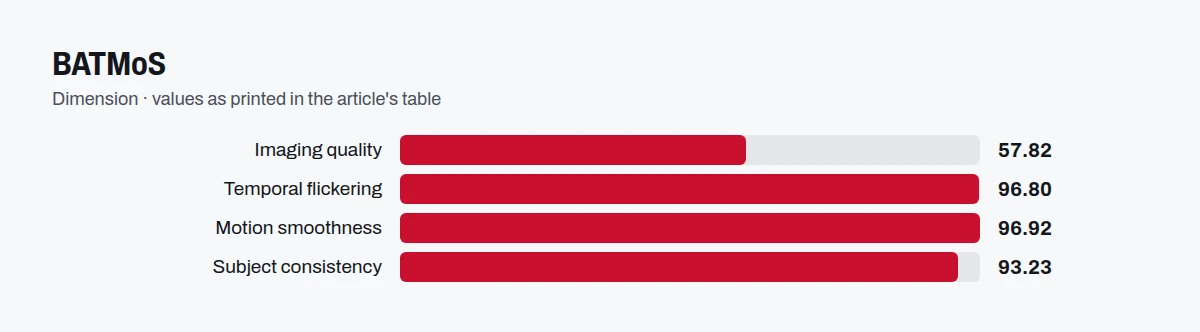
At 80 effective NFE, BATMoS and TeaCache both round to 79.40 on quality. Underneath that tie, the dimensions diverge: BATMoS scores 57.82 on imaging quality against 57.24 for TeaCache, a difference of +0.58. TeaCache is ahead on the three temporal-consistency dimensions, by 0.04 to 0.13 points.
The widest of those gaps is subject consistency, at 93.23 for BATMoS and 93.36 for TeaCache, while temporal flickering is the narrowest at 96.80 against 96.84. The paper says guidance reuse refreshes the conditional prediction at every update, while residual reuse approximates internal network computation and keeps the CFG procedure, and the dimension scores make these different approximations visible. The gaps on the temporal rows are small, and the imaging gain is the only row where BATMoS leads.
Where the result holds, and which method to pick
The TeaCache comparison is reported at 80 effective NFE, and the dimension-level results show that the two approximations affect different attributes. The authors point to the 62-NFE composition as evidence that the two approaches can be used together. For a team generating footage where flicker and subject drift are the visible failures, the temporal flickering row (96.80 for BATMoS, 96.84 for TeaCache) and the subject consistency row (93.23 against 93.36) both favour TeaCache by a small margin. For content judged on sharpness and frame quality, the imaging row favours BATMoS. Because the two methods act on different parts of the sampler, stacking them is the option the paper’s modeled 58.2 seconds describes, and it is the one to test first on CogVideoX-2B before choosing either alone.
Related coverage: TRQ rotates KV-cache frames before 2-bit quantization, lifting subject consistency over QVG.
Follow and ask
Add to Preferred Sources on Google
Summarise with AI:ChatGPTClaudePerplexityGoogle AI
How we built this
Published resultsTable 4 of the paper: Guidance allocation and feature reuse affect different attributes
Rows of Table 4 of the paper (arXiv HTML version), copied cell for cell by our code; a two-row header is shown as "group: column"; an empty name cell repeats the name above it. These are the authors' own figures, not an independent test.
Sources
The sources this article was written from. Links open the original page.