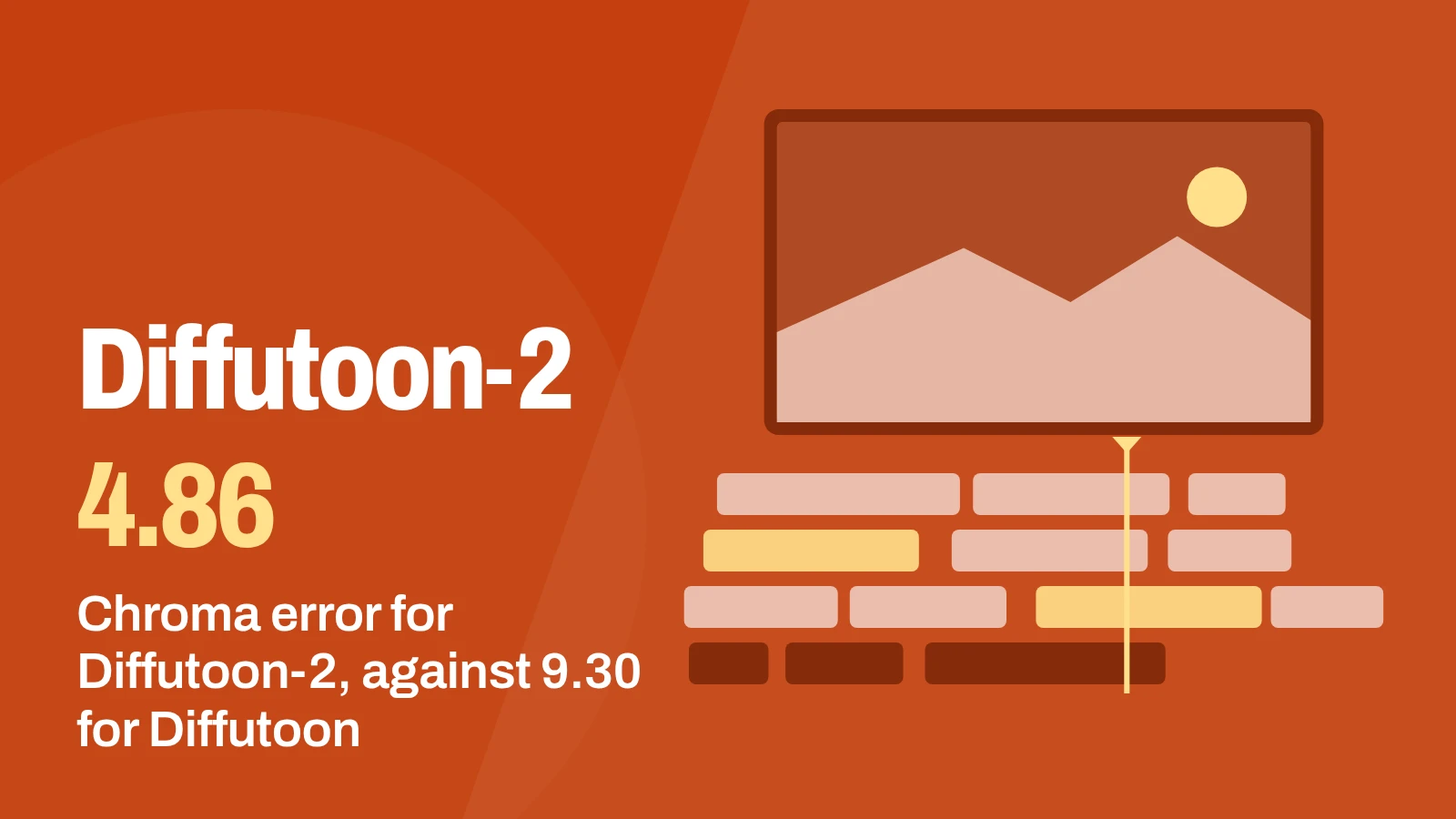
The Diffutoon-2 paper says the toon-shading method reaches the lowest Chroma error in its comparison, 4.86, against 9.30 for the earlier Diffutoon (arXiv). The abstract adds that Diffutoon-2 outperforms general-purpose and domain-specific baselines on quantitative metrics and in human evaluation (arXiv). For anyone choosing between Diffutoon and its successor to stylise footage while keeping the source colours, the Chroma gap is the number to re-check on their own clips.
Colour preservation: 4.86 versus 9.30
The authors frame the Chroma error as a measure of how well colour is preserved, and they report that Diffutoon-2 improves on Diffutoon in this respect. Diffutoon-2 scores 4.86 and the baseline Diffutoon scores 9.30, so the new method’s error is a little over half of its predecessor’s. The paper’s results table gives the Diffutoon-2 row as a series of values that begins with 0.64 and 4.86.
The evaluation used 70 photorealistic videos, compared against open-source and closed-source systems. Of these, 30 were selected at random from PixaBay100 and 40 from the combined training and validation sets of DAVIS2017. A set of 70 clips is small, so a gap as large as the one in Chroma error is more informative than small differences on the other columns.
What the ablation shows about Gaussian filtering
The paper also tests an RGB-conditioned variant trained and run without Gaussian filtering. That ablation variant keeps source colours reasonably well, with a Chroma error of 9.65, but its CLIP score falls from 30.5 to 21.8. The Chroma error of 9.65 for this ablation variant sits close to the 9.30 reported for Diffutoon, while the full Diffutoon-2 row shows 4.86. The drop in CLIP score suggests that colour fidelity alone does not make the output usable, and that the filtering step matters for the match with the intended style.
Recent DiffSynth-Studio entries and their VRAM figures
In the table below, each row gives “Date”, “Entry, as written by the project”, “Source page”.
| Date | Entry, as written by the project | Read on |
|---|---|---|
| 2026-11-23 | DiffSynth-Studio now supports unified multi-GPU parallel inference, covering most models within the framework.** Provided you have sufficient hardware resources, fully unleash the potential of your GPUs! Please refer to the documentation. | 2026-11-24 |
| 2026-11-23 | The framework has added a KV-Cache compression module. Currently supported compression methods include EntroPack, SVD, and Cholesky-QR, among which EntroPack delivers the best performance. It can be used to reduce the VRAM required by the KV-Cache, and is applicable to Qwen-Image-2.1, Qwen-Image-2.1-Turbo, and Wan2.2-Animate-2-14B. For details, see the documentation. | 2026-11-24 |
| 2026-11-23 | We trained an image super-resolution model, DetailScale-SR, which integrates multiple model capabilities such as text rendering, transparent backgrounds, and detail intensity control. The model architecture adopts LoRA + Diffusion Template. Now you can confidently feed blurry images into the model to render high-definition images with rich details. | 2026-11-24 |
| 2026-11-19 | We trained a MiniMax-H3-Image Training Adapter for the CFG-distilled MiniMax-H3-Image base, a DeCFG LoRA training adapter. The training data comes from the self-generated MiniMax-H3-Image-Self-Generated-Dataset. Based on this adapter, we trained a toy model, MiniMax-H3-Image-Songyu-LoRA (character identity), as a reference for inference and fine-tuning. In addition, for MiniMax-H3-Image we recommend training on images larger than 2048×2048 resolution. | 2026-11-24 |
| 2026-11-10 | We now support MiniMax-H3-Image, the image model of the MiniMax-H3 family, including unified text-to-image and reference-image editing inference, low VRAM inference, and full/LoRA training. The checkpoint is distilled to six sampling steps with one transformer output head per step, and it generates about 16-megapixel images without an upscaler. In addition, we provide EntroPack quantized models for the AdaLN-pruned transformer, from 8-bit down to an extreme 3-bit quantization, each level with an INT8 GEMM counterpart; the extreme 3-bit package shrinks the DiT from 40.2 GB in bfloat16 to 7.67 GB. See the documentation and example code. | 2026-11-24 |
| 2026-10-21 | We now support Fibo 2.0, including unified text-to-image and image editing inference, masked and multi-reference editing, text rendering, low VRAM inference, and full/LoRA training for both text-to-image and image editing on Fibo-2.0-dev. See the documentation and example code. | 2026-11-24 |
| 2026-10-20 | We now support MOSS-Image, including inference and training for MOSS-Image-Base and MOSS-Image-SFT. In addition, we provide an EntroPack low-bit quantized model, which can run the 3.5-bit quantized model with as little as 4 GB of VRAM; and an accelerated model distillation-accelerated via OPD training, supporting 8-step ultra-fast inference. | 2026-11-24 |
| 2026-10-16 | flux-3-image-klein open-sourced, welcome a new member to the image model family! Support includes text-to-image generation, multi-reference editing, layout control, low VRAM inference, and Base training capabilities. For details, please refer to the documentation and example code. We quantized the model with EntroPack, providing pre-quantized models in 3-bit, 4-bit, and 6-bit versions at DiffSynth-Studio/flux-3-image-klein-entropack. | 2026-11-24 |
Separately, the DiffSynth-Studio repository’s release notes show a run of entries from the past six weeks, the newest dated 2026-11-23. On that date the project added unified multi-GPU parallel inference covering most models in the framework. It also added a KV-Cache compression module with the methods EntroPack, SVD and Cholesky-QR, of which the project says EntroPack performs best.
For MiniMax-H3-Image, the 2026-11-10 entry says the extreme 3-bit EntroPack package shrinks the DiT from 40.2 GB in bfloat16 to 7.67 GB. The same entry describes a checkpoint distilled to six sampling steps that generates about 16-megapixel images without an upscaler. An entry dated 2026-11-19 recommends training MiniMax-H3-Image on images larger than 2048×2048 resolution. On 2026-10-20 the project said its 3.5-bit quantized MOSS-Image model can run with as little as 4 GB of VRAM, and that a distilled variant supports 8-step inference.
Across these rows, EntroPack quantisation recurs for MiniMax-H3-Image, MOSS-Image and flux-3-image-klein, where 3-bit, 4-bit and 6-bit versions are offered. The pattern in the MiniMax-H3-Image and MOSS-Image rows is that low-bit packaging is being used to bring large image transformers within reach of smaller GPUs. Someone budgeting VRAM for a MiniMax-H3-Image setup can compare the 40.2 GB bfloat16 DiT with the 7.67 GB 3-bit package before deciding whether a single card is enough.
Which entries matter to someone running video models
Most of the recent entries concern image models, including Fibo 2.0 on 2026-10-21 and the image super-resolution model DetailScale-SR on 2026-11-23.
The Diffutoon-2 paper’s own scores, such as its human-evaluation row beginning with 4.47, remain the reference for judging output quality.
Related coverage: ScoutCache, a training-free method, reports up to 2.28× speedup on Self-Forcing.
Follow and ask
Add to Preferred Sources on Google
Summarise with AI:ChatGPTClaudePerplexityGoogle AI
Where to try it
From the source: raw.githubusercontent.com/modelscope/DiffSynth-Studio/HEAD/README.md and Licence of the repository modelscope/DiffSynth-Studio on GitHub.
Abracadabrax lists Topaz Image Upscale, Clarity Skin and ESRGAN 4x for upscaling. Upscaling on Abracadabrax
Abracadabrax has a $1 trial for 7 days; it then renews monthly on the plan you pick, from $34 a month, until you cancel.
How we built this
Release historyDated release entries published by the project
Dated entries read by our code from the project's own release notes, news list or changelog, newest first, with the page each was read from; the entry text is the project's own wording, not a check of what it says. Each entry is shown whole. A link in an entry is shown as its text; the source page has it. Rows: the newest 8 of 92.
Sources
The sources this article was written from. Links open the original page.
- arXivDiffutoon-2: Toon Shading with Video Diffusion Modelsarxiv.org
- arXivDiffutoon-2: Toon Shading with Video Diffusion Modelsarxiv.org
- GitHubhttps://github.com/modelscope/DiffSynth-Studio: page linked by the paper as its resourceraw.githubusercontent.com
- GitHubLicence of the repository modelscope/DiffSynth-Studio on GitHubapi.github.com
- AbracadabraxAbracadabrax: upscalingabracadabrax.app