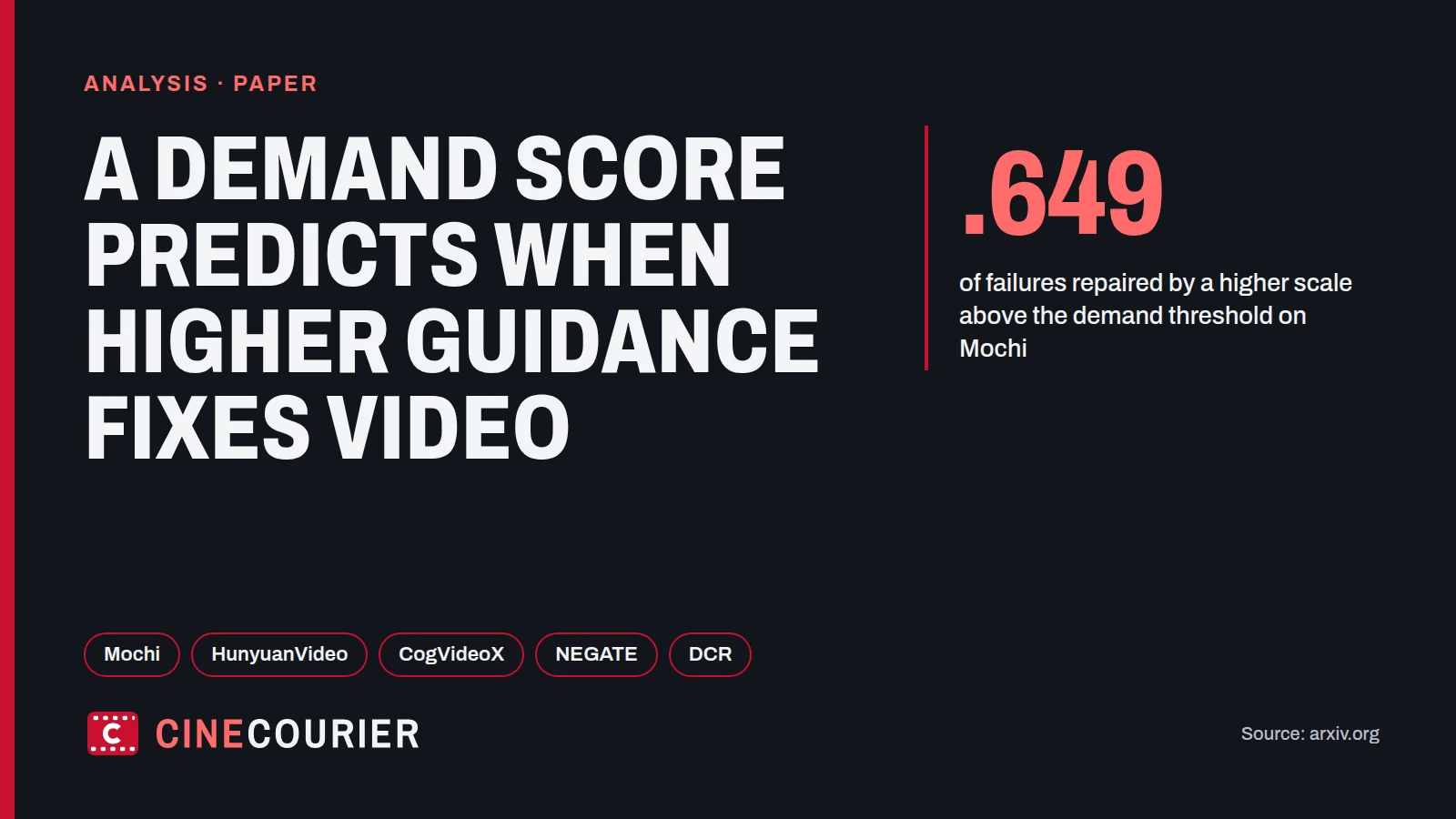
An arXiv paper on text-to-video failures reports that on Mochi, raising the guidance scale repairs .649 of failures when a demand score is above a fitted threshold, and .385 below it (arXiv). Below the threshold the scale does about as well as generating again, and the authors say DCR is the better choice there. For practitioners the point is triage: the score is read early in denoising, so it can guide the choice of fix after a clip fails (arXiv).
What the demand score is
The authors define demand as a score of how strongly the denoiser reacts to the part of the prompt that a failed video leaves out. It can be read from the first quarter of denoising, before any video exists. According to the paper, the score costs about a quarter of the computation of one video.
The paper states a condition for when a larger scale helps: the prompt must contain no negation and no event tied to a specific time, and demand must be sufficiently high. That turns a vague tuning habit into a rule that can be checked per prompt.
Where a higher scale does nothing
On Mochi, raising the guidance scale lowers the rare-composition failure rate from .472 to .297, but it does not help negations or temporal prompts. On temporal prompts, raising the scale does nothing in the authors’ data: the failure rate moves from .495 to .527 (p=.32). For negation prompts the paper offers an explanation for the weak recovery: the model’s reaction may point toward the mentioned object rather than away from it, so naming vehicles can make them more likely even after the word no. According to the authors, a bigger scale cannot reverse the direction of that reaction.
For negation, the paper points to a different kind of correction, one that steers away from the unwanted content. On Mochi negation prompts, NEGATE repairs 50.0% of failures.
What Table 2 shows across three models
| Table block | Negation | Rare comp. | Temporal | Source page | |
|---|---|---|---|---|---|
| (a) Correlation between demand and failure, within each failure type | Mochi | +0.092 | -0.176 | -0.116 | https://arxiv.org/html/2611.23025 |
| (a) Correlation between demand and failure, within each failure type | HunyuanVideo | +0.290 | -0.345 | -0.267 | https://arxiv.org/html/2611.23025 |
| (a) Correlation between demand and failure, within each failure type | CogVideoX | +0.148 | -0.070 | -0.043 | https://arxiv.org/html/2611.23025 |
The table gives the correlation between failure and demand within each failure type, for Mochi, HunyuanVideo and CogVideoX. Failing negation prompts have higher demand than succeeding ones, while failing rare-composition and temporal prompts have lower demand, and the direction is the same on all three models. The negation correlation runs from +0.092 on Mochi to +0.290 on HunyuanVideo. The sign flip between negation and the other two types is what makes demand usable as a guide: a high score is good news for rare composition but a warning sign for negation. The correlations are not large, and CogVideoX is the weakest case, at +0.148 for negation, -0.070 for rare composition and -0.043 for temporal prompts. HunyuanVideo shows the strongest values, such as -0.345 for rare composition, against -0.176 on Mochi.
The authors also report that a demand score measured on one model predicts untreated failures on another about as well as the second model’s own score does. The paper adds that the circumstances in which a raised scale helps vary from one model to another.
Limits on how far the result goes
The results for the treated clips were established on Mochi. The raised scale behaves differently on CogVideoX, so the paper says the conditions should be measured again on each model, and the demand measurement is what carries over. Every failure label comes from one judging model under fixed written instructions. Repeats with shared seeds, a re-seed control and a sweep over five scales agree with the three outcomes the paper reports.
Predictive gains from demand are modest, so the authors treat it as a guide for choosing what to try after a failure, not as a detector of failures. Within rare composition, predictors built from the text are at chance on two of three models, with AUROC .520 and .523, where .500 is chance. In the lowest quartile of demand the interval for the raised scale includes zero, so the benefit there is not separated from no effect.
The boundary the authors map is specific to corrections that act in the classifier-free guidance update, and whether other methods obey the same demand threshold is the natural next question. In practice, anyone using this on another model would need to measure the threshold again before trusting the .649 figure, which the paper reports for Mochi.
How we built this
Published resultsTable 2 of the paper: What demand shows
Rows of Table 2 of the paper (arXiv HTML version), copied cell for cell by our code; a two-row header is shown as "group: column"; an empty name cell repeats the name above it. These are the authors' own figures, not an independent test. The first column is the block of the table the row sits in. A block with its own column names is not shown. Rows: the first 3 of 6. Of its 2 blocks, not shown: (b) AUROC gained by adding demand to all text-only predictors (3 rows).
Sources
The sources this article was written from. Links open the original page.