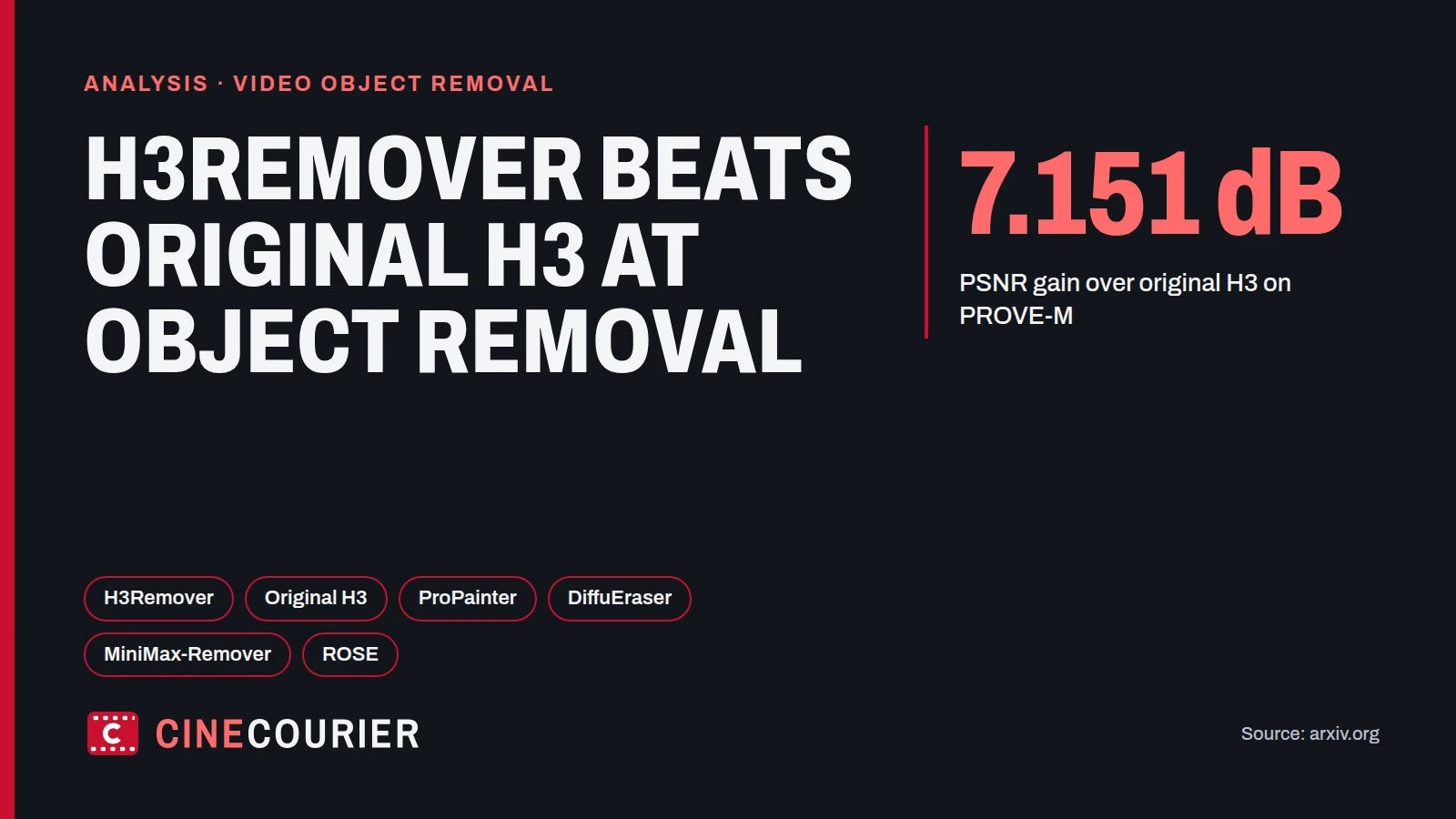
The authors of H3Remover report that, on the PROVE-M benchmark, their method improves PSNR by 7.151 dB over original H3, lowers LPIPS by 60.3% and FVD by 84.7%, and raises sampled-frame confirmed removals from 40/80 to 73/80 (arXiv). The abstract summarizes this as substantial reconstruction gains over original H3, with qualitative comparisons showing more effective object removal and better preservation of surrounding scene content (arXiv).
What the paper does
According to the paper, H3Remover reinforces MiniMax-H3 Base Ref2VA for video object removal without paired object-free training targets. Its training procedure, called DiffusionART, optimizes LoRA adapters with the backbone frozen. The full model uses reward coefficients of (1,1,5,0.05). For a practitioner, a frozen backbone means the learned change sits in small adapter weights rather than in a retrained base model.
PROVE-M results
Table 1 of the paper compares H3Remover with ProPainter, DiffuEraser, MiniMax-Remover, ROSE and EffectErase on PROVE-M. Against the best baseline for each metric on PROVE-M, the authors report PSNR higher by 1.395 dB, LPIPS lower by 18.9% and FVD lower by 42.0%. The margin over the strongest competitor is therefore much smaller than the margin over original H3, which suggests that much of the headline gain reflects how far original H3 trails on this task rather than a lead over specialised removers. Because these are the authors’ own figures, they are not an independent test.
Exploratory results on WIPER
| Method | WIPER: RC-S ↑ | WIPER: RC-T ↓ | WIPER: S/N (%) ↑ | KITTI-360: RC-S ↑ | Source page |
|---|---|---|---|---|---|
| ProPainter | 0.2795 | 0.5495 | 63.33 | 0.3252 | https://arxiv.org/html/2611.24633 |
| DiffuEraser | 0.4252 | 0.4313 | 76.67 | 0.3910 | https://arxiv.org/html/2611.24633 |
| ROSE | 0.4408 | 0.4153 | 90.00 | 0.3710 | https://arxiv.org/html/2611.24633 |
| MiniMax-Remover | 0.4205 | 0.2817 | 78.33 | 0.4040 | https://arxiv.org/html/2611.24633 |
| EffectErase | 0.5134 | 0.1963 | 91.67 | 0.3775 | https://arxiv.org/html/2611.24633 |
| Original H3 | 0.4294 | 0.2021 | 71.67 | 0.2514 | https://arxiv.org/html/2611.24633 |
| H3Remover | 0.5001 | 0.1413 | 100.00 | 0.4130 | https://arxiv.org/html/2611.24633 |
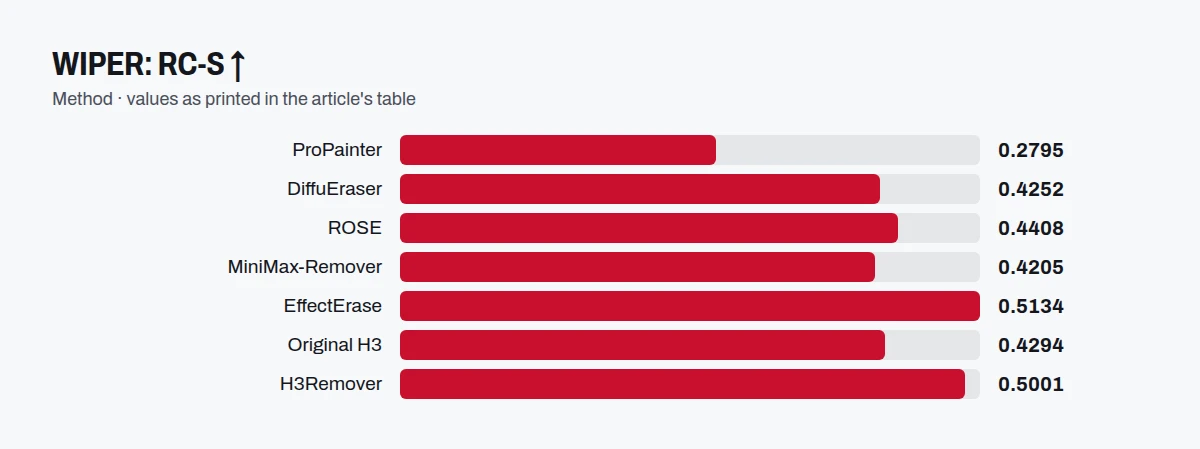
Table 2 covers 60 WIPER clips and 30 driving clips from ten scenes, split equally between KITTI-360 and Waymo, without clean references. The authors label the comparisons exploratory, because judgment layouts differ and source videos are not clean ground truth. On WIPER, H3Remover scores 0.1413 on RC-T, the lowest in the table, against 0.2021 for original H3 and 0.1963 for EffectErase. Its S/N on WIPER is 100.00, against 71.67 for original H3 and 91.67 for EffectErase, which matches the paper’s report of 60/60 confirmed removals on that set. EffectErase, however, has a higher RC-S on WIPER, 0.5134 against 0.5001 for H3Remover, and the paper’s claim of top RC-S covers only the two driving sets. On KITTI-360, H3Remover has an RC-S of 0.4130, ahead of 0.4040 for MiniMax-Remover and well above 0.2514 for original H3. Among the older removers, ProPainter has the weakest WIPER RC-S at 0.2795 and the weakest RC-T at 0.5495, while its S/N is 63.33.
Caveats and licence
The paper reports confirmed removals rising from 43/60 to 60/60 on WIPER, and on the two driving sets from 1/15 to 14/15 and from 10/15 to 14/15. The driving prompts target all visible vehicles and people for both H3 variants, but supplied-mask targets for the competing methods. Unknowns remain in the denominator of the confirmed-removal fraction.
On licensing, the terms linked from the project repository are the MiniMax H3 Community License Agreement (GitHub). It defines the excluded territories as the European Union, the United Kingdom, the Republic of Korea and the United States of America. It also says users may not use the MiniMax H3 works or their outputs or results to improve any other artificial intelligence model, other than MiniMax H3 or its model derivatives.
What the sources we read do not state
We check six facts on every story in the full text of each source. The pages listed under Sources do not state hardware requirements.
How we built this
Published resultsTable 2 of the paper: Exploratory results without clean references
Rows of Table 2 of the paper (arXiv HTML version), copied cell for cell by our code; a two-row header is shown as "group: column"; an empty name cell repeats the name above it. These are the authors' own figures, not an independent test. The table has 10 columns; 5 shown, with every column that holds a figure this article gives or a measure it names. Not shown: KITTI-360: 2 more columns, Waymo (3 columns).
Sources
The sources this article was written from. Links open the original page.