On their HandBench test set, the LynnReal-Hand authors report an FVD of 181.67 and a MANO Dice of 93.02 for the full-sequence model, and a MANO Dice of 92.49 for the three-step causal model (arXiv). The project describes LynnReal-Hand as a hand-controlled video world model that conditions generation on an initial image, a text prompt, hand motion and camera poses, so the figures bear on how well video follows hand motion (GitHub). The release also ships a lighter VAE decoder, and the project’s own table shows what that decoder trades away.
What the model takes in and produces
According to the project’s GitHub page, LynnReal-Hand takes an initial image, a text prompt, hand motion and camera poses, and generates videos of interactions across everyday and imagined environments. The repository provides inference code, model downloads and example inputs. The authors built HandBench as a standardized testbed of 200 sequences, with 20 clips per source. The headline scores above are therefore measured on that benchmark, which the authors constructed themselves, and not on an outside test set.
The Fast variant and its hardware
The Hugging Face page for the Fast preview says its default compiled decoder and accelerated inference path require one visible NVIDIA H200, and that other GPU configurations are not validated by this release (Hugging Face). For practitioners, that makes the Fast variant a datacenter-class option for now, whatever its sampling-step count.
In the paper’s limitations section, the authors say the local two-chunk causal window (W2) prioritizes streaming latency but lacks explicit long-term 3D memory. They add that persistent spatial memory could improve object permanence when objects leave and re-enter the view. That is a caveat for the three-step causal model, whose MANO Dice is 92.49 on HandBench.
VAE decoding: smaller, with a quality cost
| Decoder | Params (M) ↓ | PSNR (dB) ↑ | LPIPS ↓ | Temporal error ↓ | Source page |
|---|---|---|---|---|---|
| Native H3 | 2423.5 | 35.04 | 0.0434 | 9.05 | https://raw.githubusercontent.com/LynnReal-AI/LynnReal/HEAD/README.md |
| Tiny-H3 | 9.9 | 30.40 | 0.1040 | 13.78 | https://raw.githubusercontent.com/LynnReal-AI/LynnReal/HEAD/README.md |
| StreamRender¹ | 1617.8 | 33.74 | 0.0533 | 10.09 | https://raw.githubusercontent.com/LynnReal-AI/LynnReal/HEAD/README.md |
| StreamRender² | 1617.8 | 33.95 | 0.0516 | 9.88 | https://raw.githubusercontent.com/LynnReal-AI/LynnReal/HEAD/README.md |
| SolarX V3 | 2423.5 | 34.09 | 0.0484 | 10.20 | https://raw.githubusercontent.com/LynnReal-AI/LynnReal/HEAD/README.md |
| LightVAE | 1752.1 | 35.13 | 0.0423 | 8.97 | https://raw.githubusercontent.com/LynnReal-AI/LynnReal/HEAD/README.md |
| Ultra-Fast-VAE | 361.2 | 34.43 | 0.0511 | 9.80 | https://raw.githubusercontent.com/LynnReal-AI/LynnReal/HEAD/README.md |
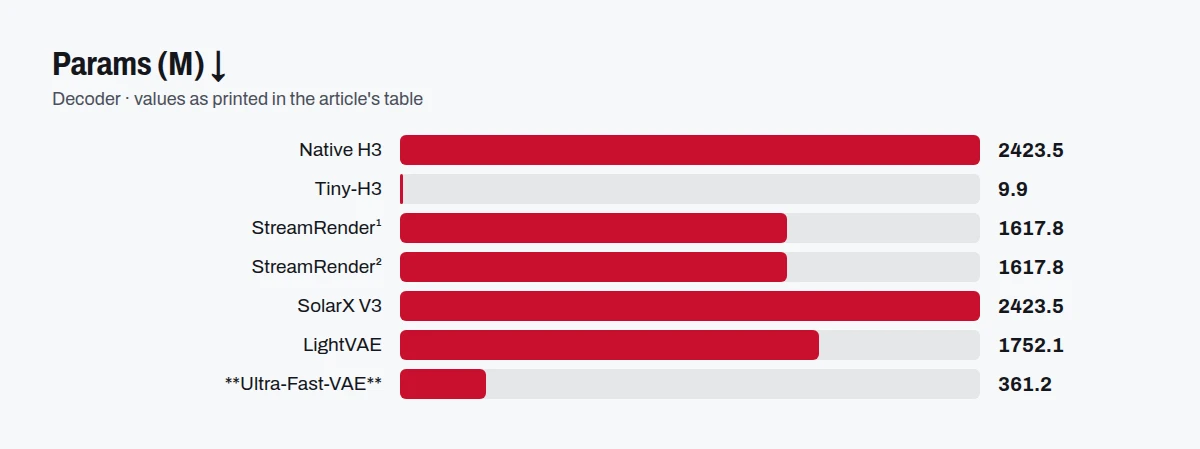
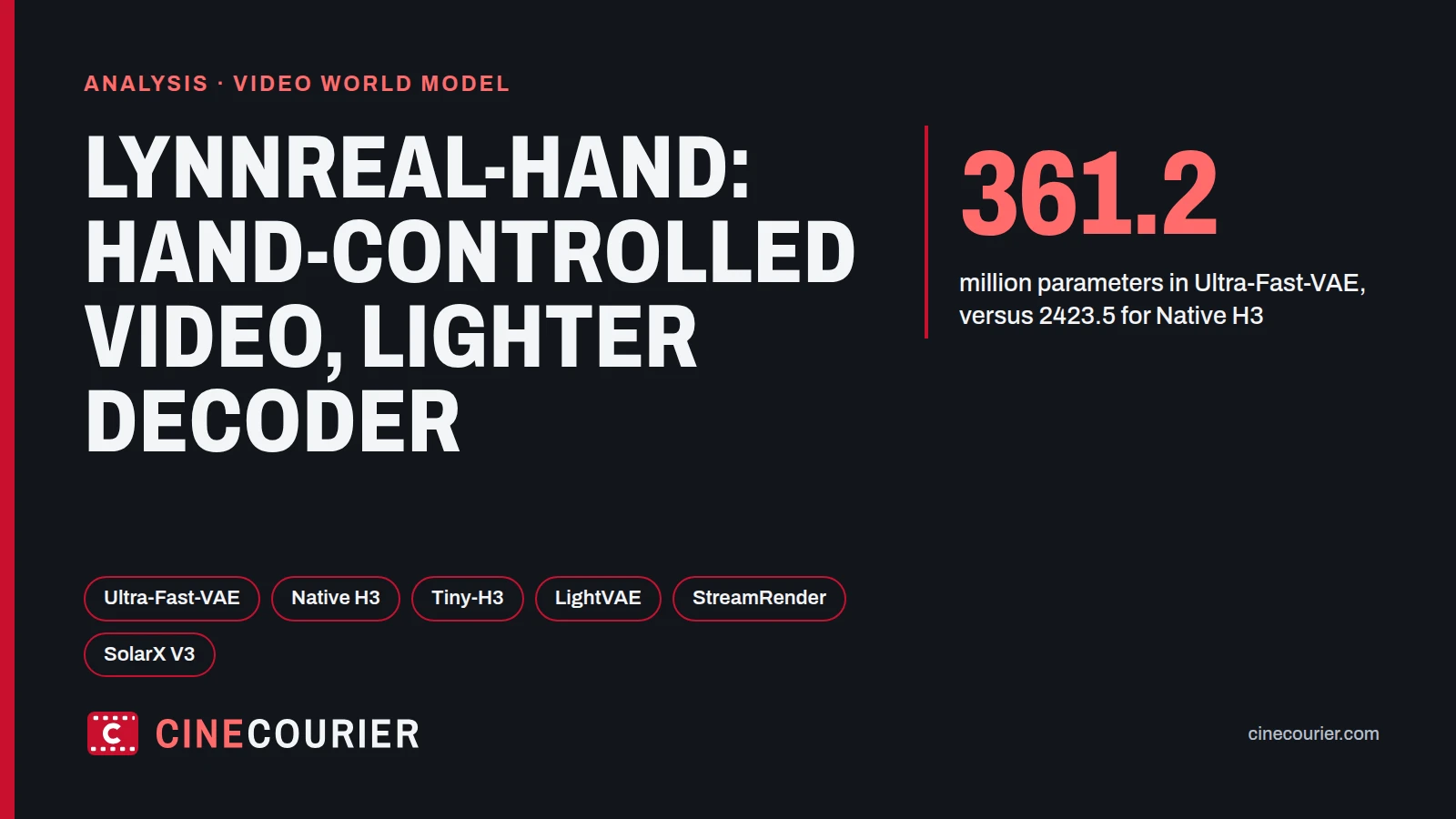
The paper says Ultra-Fast-VAE, in standalone decoding benchmarks, reduces parameter count by 6.7× relative to Native H3, at 361.2M versus 2423.5M, and reaches 34.43 dB PSNR. Against Native H3, Ultra-Fast-VAE gives up some PSNR in the table: 34.43 dB against 35.04 dB. Its LPIPS of 0.0511 is higher than Native H3’s 0.0434, and its temporal error of 9.80 is above Native H3’s 9.05, so the smaller decoder is measurably less faithful on all three quality columns. Among the other decoders, Tiny-H3 is far smaller at 9.9M parameters but drops to 30.40 dB PSNR and a temporal error of 13.78, a larger loss than Ultra-Fast-VAE accepts. LightVAE posts the best quality figures in the table, 35.13 dB and 0.0423 LPIPS, but at 1752.1M parameters it is nearly five times the size of Ultra-Fast-VAE’s 361.2M. Ultra-Fast-VAE also beats the StreamRender rows on PSNR, 34.43 against 33.74 and 33.95, with far fewer parameters than their 1617.8M.
Licence terms for the weights
The weights are available through Hugging Face under the MiniMax H3 Community License Agreement, which requires commercial products or services using the works to prominently display “MiniMax H3” in their user interface (Hugging Face, Hugging Face). That licence names the European Union, the United Kingdom, the Republic of Korea and the United States of America as Excluded Territories. It also bars using the works or their outputs to improve any other AI model, other than MiniMax H3 or its Model Derivatives. For teams in those regions, or those that plan to distil outputs into another model, the licence rules out the obvious uses, whatever the benchmark numbers say.
How we built this
Published resultsThe table "VAE decoding" in the project's README
Rows of the table "VAE decoding" published in the project's README, copied cell for cell by our code, with the page address. These are the project's own figures, not an independent test. The table has 7 columns; the first 5 shown. Not shown: Latency (ms) ↓, FPS ↑.
Sources
The sources this article was written from. Links open the original page.
- arXivLynnReal-Hand: Unlocking World Interaction with Hand Controlarxiv.org
- GitHubhttps://github.com/LynnReal-AI/LynnReal: page linked by the paper as its resourceraw.githubusercontent.com
- Hugging Facehttps://huggingface.co/shaohao011/LynnReal-Hand-Base-1.0: page linked by the paper as its resourcehuggingface.co
- Hugging Facehttps://huggingface.co/shaohao011/LynnReal-Hand-Fast-preview: page linked by the paper as its resourcehuggingface.co
- Hugging FaceLicence or terms of use linked by https://huggingface.co/shaohao011/LynnReal-Hand-Base-1.0huggingface.co