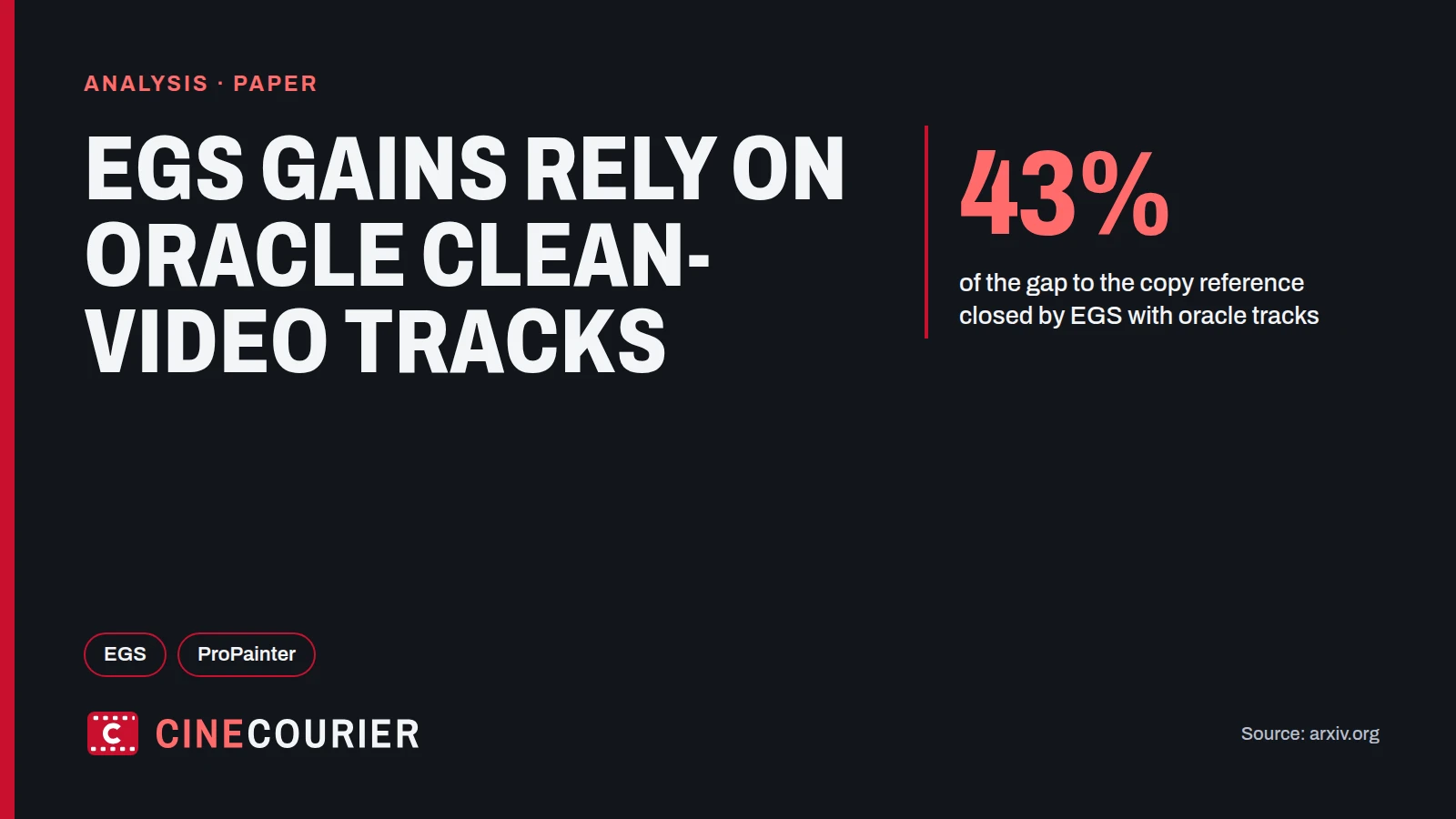
A new arXiv paper on diffusion video inpainting and object removal says its training-free sampler, evidence-guided sampling (EGS), closes 43% and 56% of the gap to a copy reference on held-out DAVIS when its colors come from clean-video tracks (arXiv). For practitioners, the point is that the headline gain depends on clean-video evidence that a real removal job does not have, so the oracle figures read as an upper bound on what the method delivers.
A metric that separates what can be recovered
The authors propose recoverability-stratified evaluation, in which a point tracker run on the clean video labels each hole pixel by whether it is observed elsewhere in the clip and how far away. Fidelity and temporal stability are then reported per stratum against a copy reference, instead of as one average over the whole hole. This matters because a single score mixes pixels that exist elsewhere in the video with pixels that must be invented, and the two cases call for different judgments.
According to the paper, the diffusion removers’ DAVIS hole warping error is two to four times that of ProPainter. It also says that copying along clean-video tracks lowers the diffusion removers’ recoverable LPIPS by a quarter to two fifths. Read together, these results suggest that the diffusion removers leave usable evidence from other frames on the table, and that they are less stable over time than propagation-based methods.
What EGS does and where the evidence comes from
EGS blends tracked colors into the clean-latent prediction of a video diffusion remover, and it needs no training. With oracle evidence from clean-video tracks, the paper says EGS closes 43% and 56% of the gap to the copy reference on held-out DAVIS. Because those figures describe EGS with oracle evidence, they show the best case rather than a deployable pipeline. The paper only hypothesizes that tracked colors limit the gain, and it says a paired interval on the difference between the runs would test this (arXiv).
Evaluation data and a caveat on warping error
The evaluation setup uses DAVIS, which provides 50 clips with the E2FGVI test masks and takes the original video as ground truth. It also uses PROVE-M, which provides 80 real paired captures. On PROVE-M, the paper notes that the masks cover the object but not its shadows and reflections.
The paper also warns against reading warping error as a pure quality score. ProPainter’s unrecoverable-pixel warping error is 0.71, below the ground-truth 1.47, which the paper takes to mean that part of the contrast reflects over-smoothing by propagation. A lower warping error can thus come from blur as well as from stability, so the two-to-four-times gap should be read with that in mind.
Commercial API prices for comparison
| Tool and model | Price | Resolution | Clip length | Source page |
|---|---|---|---|---|
| MiniMax (Hailuo / H3 video): MiniMax-H3-Regeneration | $0.05 (Output Video per second) | 768P → 2K | — | https://platform.minimax.io/docs/pricing/overview.md |
| MiniMax (Hailuo / H3 video): MiniMax-H3-Context-IR | $0.90 (Input Price per M tokens) | — | — | https://platform.minimax.io/docs/pricing/overview.md |
| MiniMax (Hailuo / H3 video): MiniMax-Hailuo-2.3-Fast | $0.19 per 768P, 6s video | 768P | 6s | https://platform.minimax.io/docs/pricing/overview.md |
| Runway API: aleph2 | 28 credits per second (56 credit minimum per generation) | — | — | https://docs.dev.runwayml.com/guides/pricing/ |
| Runway API: gen4.5 | 12 credits per second | — | — | https://docs.dev.runwayml.com/guides/pricing/ |
| Runway API: gen4_turbo | 5 credits per second | — | — | https://docs.dev.runwayml.com/guides/pricing/ |
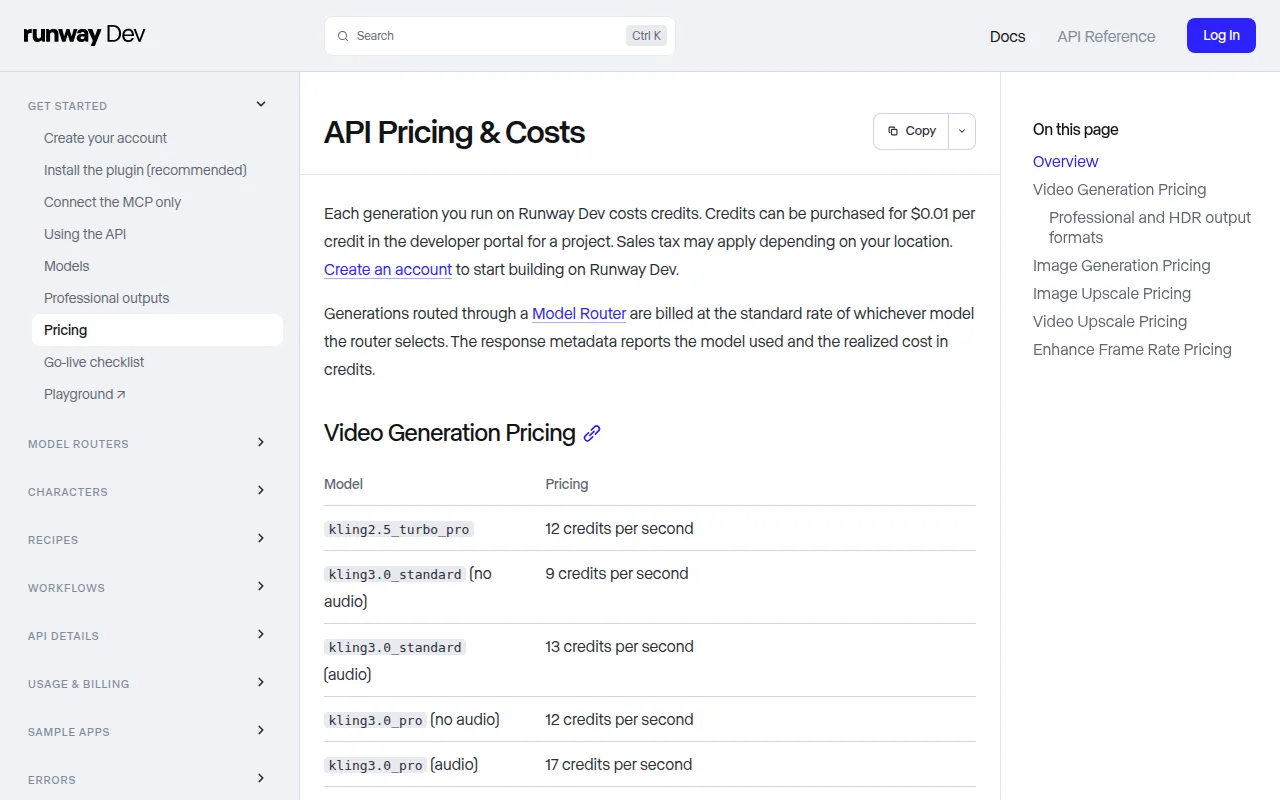
The table lists prices from the official MiniMax and Runway pages; these are commercial services, separate from the research removers evaluated in the paper, and are given only as a price reference for readers weighing hosted video tools. MiniMax prices its H3-Regeneration model at $0.05 per second of output video, with resolution listed as 768P → 2K. The MiniMax-Hailuo-2.3-Fast model costs $0.19 per 768P, 6s video. Runway’s API charges 28 credits per second for aleph2, with a 56 credit minimum per generation. The same Runway page lists gen4.5 at 12 credits per second and gen4_turbo at 5 credits per second. The MiniMax rows use dollars per output second, per clip or per million input tokens, while Runway bills in credits per second, so the rows cannot be ranked directly without a credit-to-dollar rate. Within Runway’s own list, aleph2 at 28 credits per second costs more per second than gen4_turbo at 5 credits per second, which shows how widely tiers differ within one vendor.
What the sources we read do not state
We check six facts on every story in the full text of each source. The pages listed under Sources do not state a price or hardware requirements.
How we built this
Prices and specificationsPrices and specifications on the official pages of MiniMax and Runway
Prices and specifications read by our code from the official pricing and documentation pages of the tool and of its direct competitors (same category, fixed list), with the page address and the source line for every cell, at most three rows per tool. Empty cells mean the page does not state the figure.
Sources
The sources this article was written from. Links open the original page.
- arXivRecoverability-Aware Evaluation of Diffusion Video Inpainting and Object Removalarxiv.org
- arXivRecoverability-Aware Evaluation of Diffusion Video Inpainting and Object Removalarxiv.org
- platform.minimax.ioMiniMax (Hailuo / H3 video): official pricingplatform.minimax.io
- docs.dev.runwayml.comRunway API: official pricingdocs.dev.runwayml.com