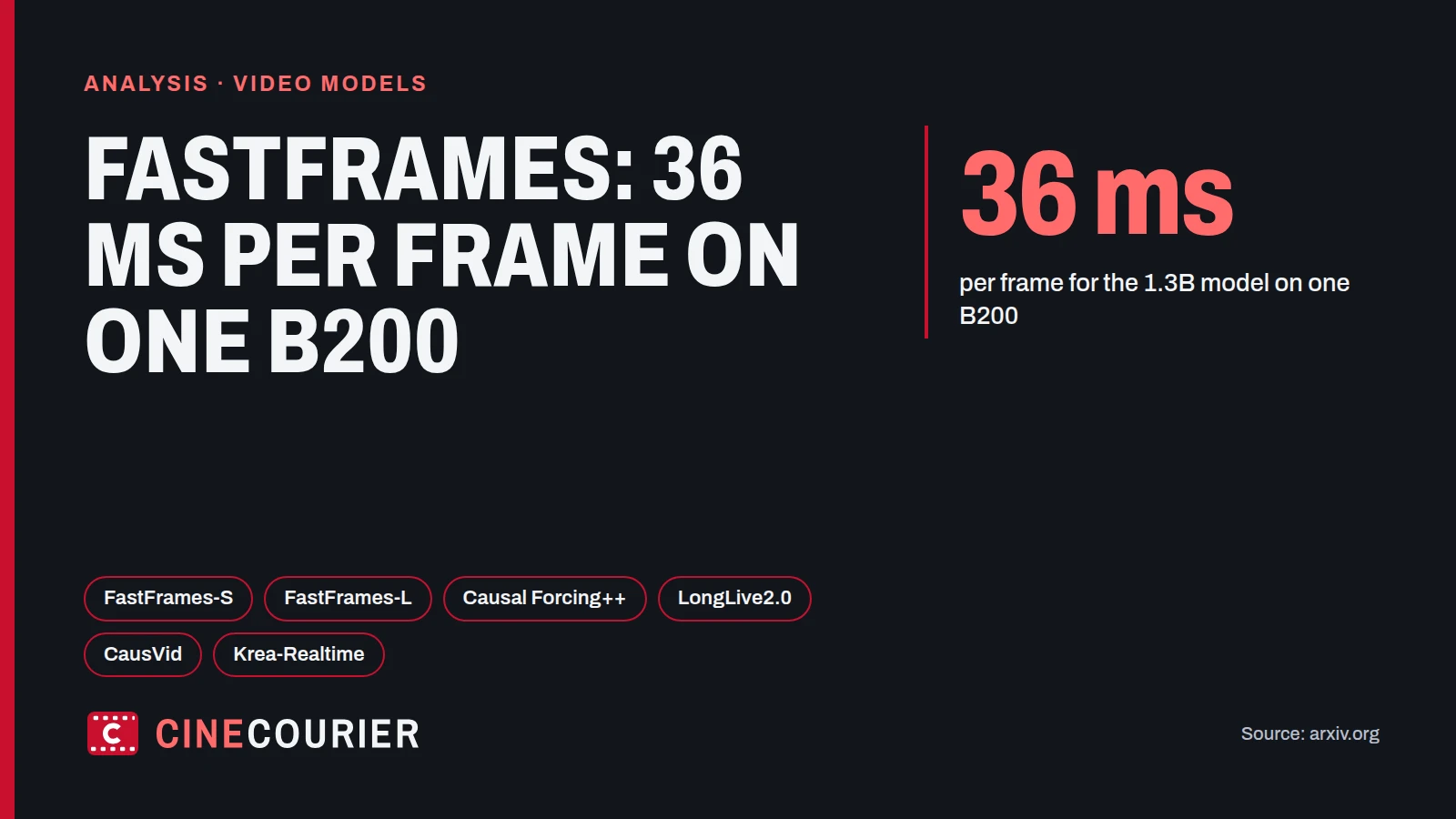
FastFrames, a paper on arXiv, presents a family of autoregressive video diffusion models that it says reach interactive latency with no loss in quality (arXiv). Its smaller 1.3B model generates a frame in 36 ms, or 28 responses per second, on one B200 GPU, and the paper says its quality matches that of a state-of-the-art model almost 8x slower. For anyone choosing a model for real-time video, the question becomes whether a 50 ms budget at 480p is reachable on current datacenter hardware (arXiv).
Profiling points at decoding and cache updates
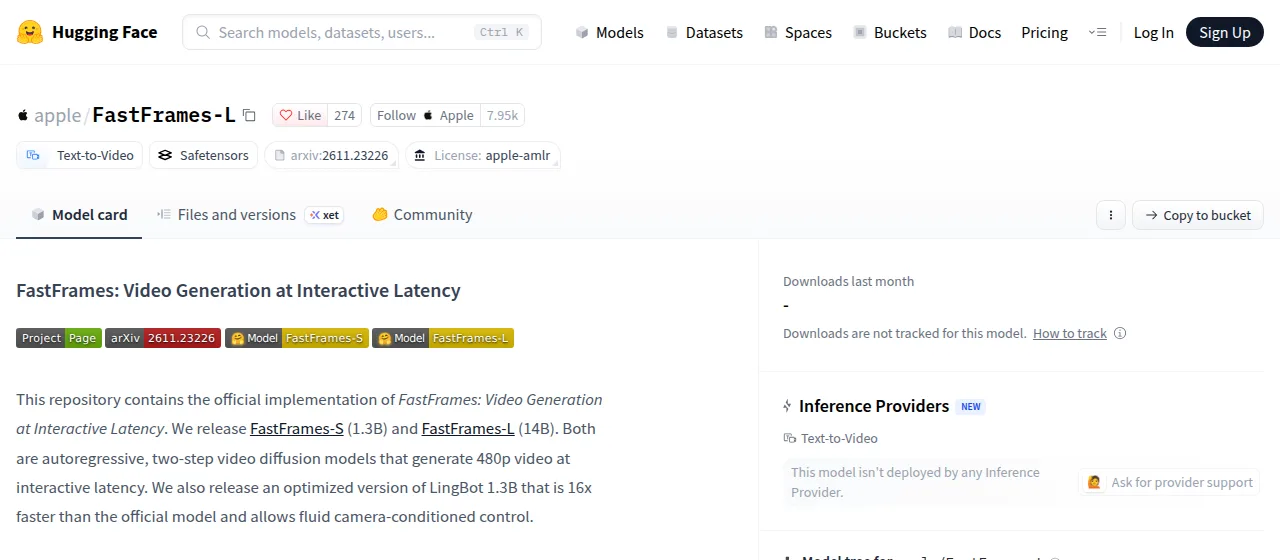
The paper starts from a profiling result: according to the authors, VAE decoding and KV cache updates account for over half of end-to-end inference latency in state-of-the-art models. That framing explains why the work targets the whole pipeline rather than only the denoising steps. The released models are autoregressive, two-step video diffusion models that generate 480p video at interactive latency, in two sizes: FastFrames-S at 1.3B and FastFrames-L at 14B (huggingface.co).
Latency at 480p and 720p
The paper gives FastFrames-S 36 ms at 480p and 127 ms at 720p, measured on a B200. FastFrames-L, the 14B model, takes 45 ms at 480p and 116 ms at 720p when spread over 8 B200 GPUs. Table 1’s caption defines the interactive target as 50 ms or less and sub-second latency as between 50 and 1,000 ms, so FastFrames-S at 36 ms and FastFrames-L on 8 GPUs at 45 ms meet the target at 480p, while FastFrames-S at 127 ms at 720p falls in the sub-second band. The larger model needs 8 GPUs for its figures, so its 116 ms at 720p is not a single-card number.
How Table 1 ranks the baselines
| Table block | Model | Size (B) | Latency (ms) ↓ | Source page |
|---|---|---|---|---|
| Bidirectional Video Models | Wan2.1 | 1.3 | 30,444 | https://arxiv.org/html/2611.23226 |
| Bidirectional Video Models | Wan2.2 | 14.3 | 117,734 | https://arxiv.org/html/2611.23226 |
| Bidirectional Video Models | MiniMax-H3 | 33.1 | 38,454 | https://arxiv.org/html/2611.23226 |
| Bidirectional Video Models | HunyuanVideo1.5 | 8.3 | 1,555,508 | https://arxiv.org/html/2611.23226 |
| Bidirectional Video Models | LTX2.5 | 19.0 | 11,264 | https://arxiv.org/html/2611.23226 |
| Autoregressive Video Models | Helios Distilled | 14.3 | 2,544 | https://arxiv.org/html/2611.23226 |
| Autoregressive Video Models | Krea-Realtime | 14.3 | 1,675 | https://arxiv.org/html/2611.23226 |
| Autoregressive Video Models | LongLive2.0 | 5.0 | 505 | https://arxiv.org/html/2611.23226 |
| Autoregressive Video Models | CausVid | 1.3 | 662 | https://arxiv.org/html/2611.23226 |
| Autoregressive Video Models | Causal Forcing++ | 1.3 | 272 | https://arxiv.org/html/2611.23226 |
The caption of Table 1 says every method gets the same prompts and seeds, runs on one B200 unless marked otherwise, and is scored at roughly 480p with its officially supported dimensions. Among the bidirectional models, Wan2.1 at 1.3 B takes 30,444 ms and LTX2.5 at 19.0 B takes 11,264 ms. Among the autoregressive models, LongLive2.0 at 5.0 B takes 505 ms and CausVid at 1.3 B takes 662 ms. The bidirectional rows run from 11,264 ms for LTX2.5 up to 1,555,508 ms for HunyuanVideo1.5, far from a 50 ms target, so the comparison that matters for interactive use is with the autoregressive block. Even there, the paper’s fastest baseline is Causal Forcing++ at 272 ms, which is sub-second but not interactive under the caption’s definition, while LongLive2.0 at 5.0 B takes 505 ms, Krea-Realtime at 14.3 B takes 1,675 ms and Helios Distilled at 14.3 B takes 2,544 ms. The 36 ms of FastFrames-S sits below every baseline latency in the rows listed here. Size alone does not explain the spread: Wan2.2 at 14.3 B takes 117,734 ms, while Krea-Realtime at the same 14.3 B takes 1,675 ms.
Licence terms and choosing between the two sizes
The Hugging Face model card for FastFrames-L declares the licence apple-amlr, and the repository says the LingBot-World v2 code and weights follow their upstream CC BY-NC-SA 4.0 licence while all other FastFrames code is under the Apple Sample Code License, so anyone planning to use the weights should read those terms first (Hugging Face). Read together, the model card’s licence line and the paper’s latency figures mean that the same release carries both usage terms and the speed claims a team would weigh. A team weighing a 1.3B model on one B200 against a 14B model on 8 B200 GPUs can see 36 ms against 45 ms at 480p, and 127 ms against 116 ms at 720p. On those numbers the smaller model already meets the 50 ms target on one card, while the larger one needs 8 to land at a similar latency.
Related coverage: Reference Forcing, per its authors, cuts drift in long AI video.
How we built this
Published resultsTable 1 of the paper: Quantitative comparisons in terms of end-to-end latency and VBench scores
Rows of Table 1 of the paper (arXiv HTML version), copied cell for cell by our code. These are the authors' own figures, not an independent test. The first column is the block of the table the row sits in. The table has 6 columns; 3 shown, with every column that holds a figure this article gives or a measure it names. Not shown: VBench ↑ (3 columns). Rows: 10 of 16, with every row whose value this article gives, or that it names; not shown: rows 6, 11, 13, 14, 15, 16. Of its 2 blocks, shown in part: Autoregressive Video Models (5 of 11 rows).
Sources
The sources this article was written from. Links open the original page.
- arXivFastFrames: Video Generation at Interactive Latencyarxiv.org
- huggingface.coFastFrames: Video Generation at Interactive Latencyhuggingface.co
- arXivFastFrames: Video Generation at Interactive Latencyarxiv.org
- Hugging FaceLicence declared in the front matter of the model card apple/FastFrames-L on Hugging Facehuggingface.co