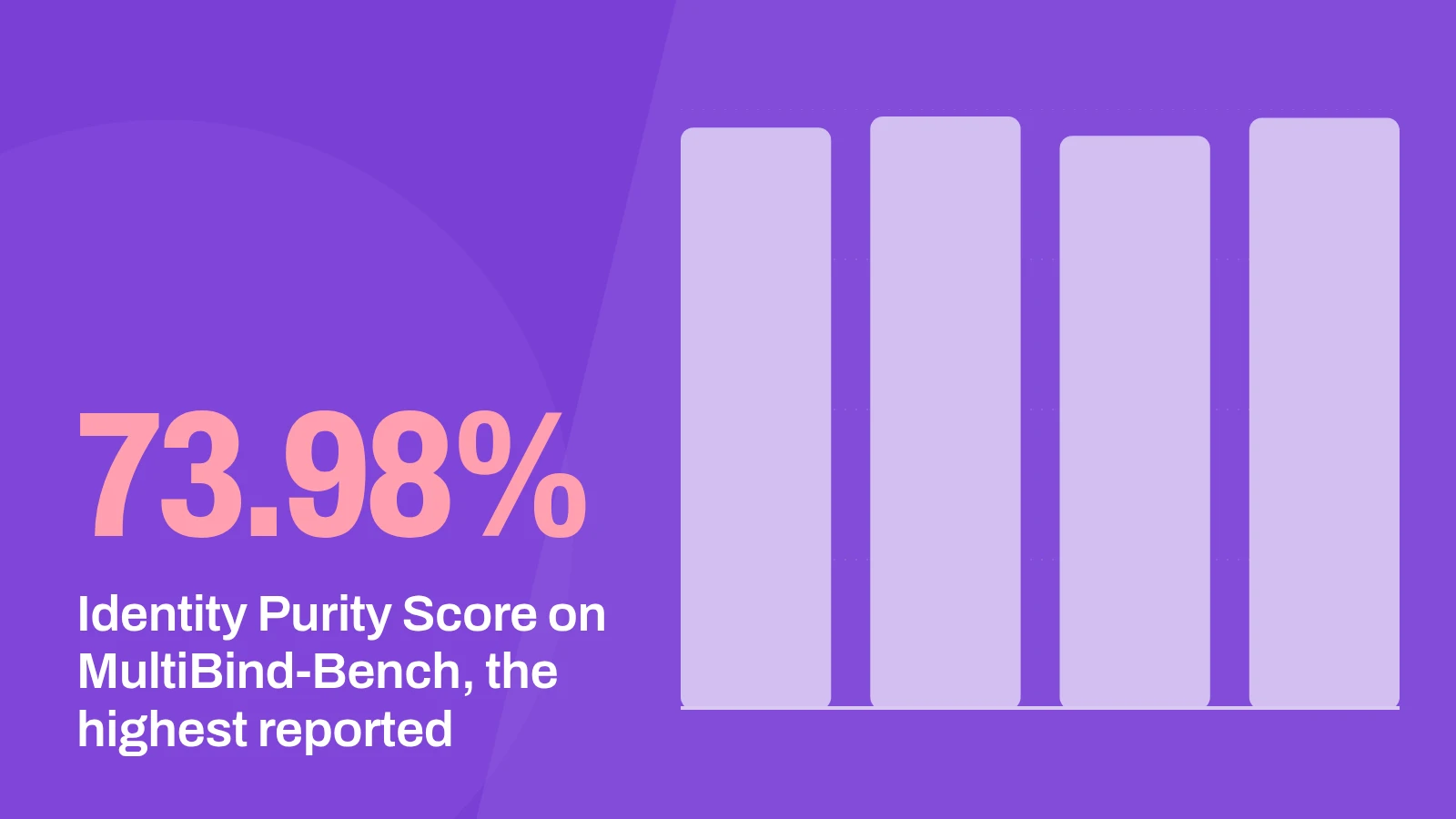
The authors of MultiBinder report in an arXiv paper that their framework reaches 73.98% in Identity Purity Score and 84.56% in Visual Reasoning Score on MultiBind-Bench, the highest scores on both metrics (arXiv). They also say that experiments on general and newly curated multi-subject benchmarks show it significantly outperforms existing methods in multi-subject identity fidelity (arXiv). For someone picking a model to keep several characters distinct in one clip, the relevant evidence is that multi-subject benchmark; on the general open-domain table the picture is mixed, as the numbers below show.
Binding subjects before the video is narrated
MultiBinder is built on what the authors call a bind-then-narrate paradigm for personalized video generation with several subjects. Their approach adds a two-stage conditioning process that runs before video diffusion. The title of the paper names the target: identity leakage, where the traits of one reference subject bleed into another in the generated clip. Conditioning each subject first, and only then composing the description of the scene, is the design choice meant to keep the references apart.
Margin over Kling-1.6 on MultiBind-Bench
The authors state that MultiBinder takes the top score on both MultiBind-Bench metrics, 73.98% in Identity Purity Score and 84.56% in Visual Reasoning Score. They name Kling-1.6 as the best competitor and give MultiBinder’s improvements over it as +4.47% and +1.67%, respectively. Kling-1.6 is a commercial model, so the comparison puts a research framework against a product, which is a harder reference than another academic baseline. The figures are the authors’ own, reported on a benchmark that they newly curated.
Open-domain table: motion amplitude up, face similarity behind Phantom
In the table below, each row gives “Method”, “Aes. ↑”, “M. Smo. ↑”, “M. Amp. ↑”, “FaceSim ↑”, “Gme. ↑”, “Source page”.
| Method | Aes. ↑ | M. Smo. ↑ | M. Amp. ↑ | FaceSim ↑ | Gme. ↑ |
|---|---|---|---|---|---|
| VACE-P1.3B | 47.34% | 96.8% | 12.03% | 16.59% | 71.38% |
| VACE-1.3B | 48.24% | 97.2% | 18.83% | 20.57% | 71.26% |
| Phantom-1.3B | 46.67% | 93.3% | 14.29% | 48.56% | 69.43% |
| MultiBinder | 48.13% | 97.06% | 32.16% | 43.45% | 69.89% |
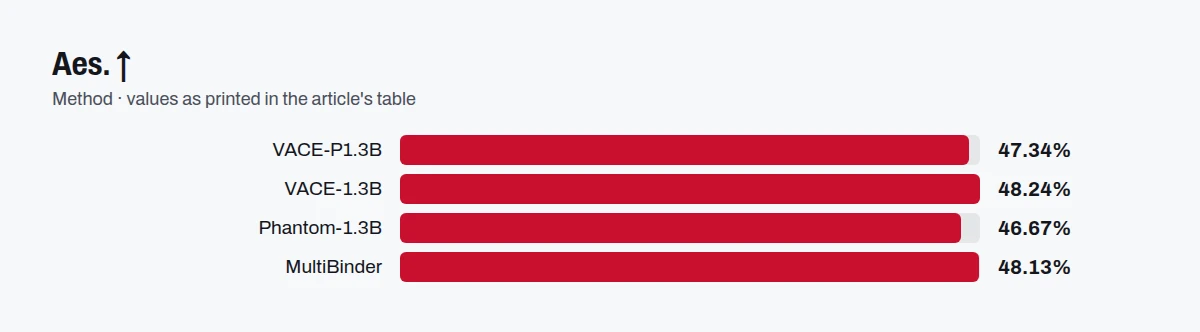
On the OpenS2V-Eval open domain, MultiBinder scores 32.16% in motion amplitude, against 12.03% for VACE-P1.3B, 18.83% for VACE-1.3B and 14.29% for Phantom-1.3B. In face similarity, Phantom-1.3B reaches 48.56% and MultiBinder 43.45%. In aesthetics, VACE-1.3B has 48.24% and MultiBinder 48.13%. In the GmeScore column, VACE-P1.3B has 71.38% and MultiBinder 69.89%. The largest gap in MultiBinder’s favour is motion amplitude, so a claim of better identity fidelity cannot be read from this table alone. Phantom-1.3B ahead on face similarity shows that the open-domain measures do not rank the methods the way the multi-subject benchmark does.
The Q-Former ablation and the scope of its gain
In the ablation, the Entity-Aware Q-Former raises the total score by 3.22% over the variant without a Q-Former, while a vanilla Q-Former adds 0.74%. The gain comes from an ablation table with its own training setting, and it isolates the binding module rather than the full system. The open-domain comparison involves 1.3B-class baselines, while the Kling-1.6 comparison involves a commercial model, so the two sets of results answer different questions. A team choosing between Phantom-1.3B and MultiBinder for multi-character clips would weigh MultiBinder’s motion amplitude of 32.16% and its benchmark identity scores against Phantom-1.3B’s 48.56% face similarity.
Not in the sources: price
We check six facts on every story in the full text of each source. The pages listed under Sources do not state a price.
Related coverage: MemCrafter paper reports 0.908 memorability score and 85.00% human hit ratio.
Follow and ask
Add to Preferred Sources on Google
Summarise with AI:ChatGPTClaudePerplexityGoogle AI
Where to try it
MegaScenes lists Kling 1.6 Pro among its video models. Kling 1.6 Pro on MegaScenes
How we built this
Published resultsTable 1 of the paper: Performance comparisons with state-of-the-art approaches
Rows of Table 1 of the paper (arXiv HTML version), copied cell for cell by our code; a two-row header is shown as "group: column"; an empty name cell repeats the name above it. These are the authors' own figures, not an independent test. The table has 9 columns; 6 shown. Not shown: Nexus. ↑, Natural. ↑, Total. ↑.
Sources
The sources this article was written from. Links open the original page.