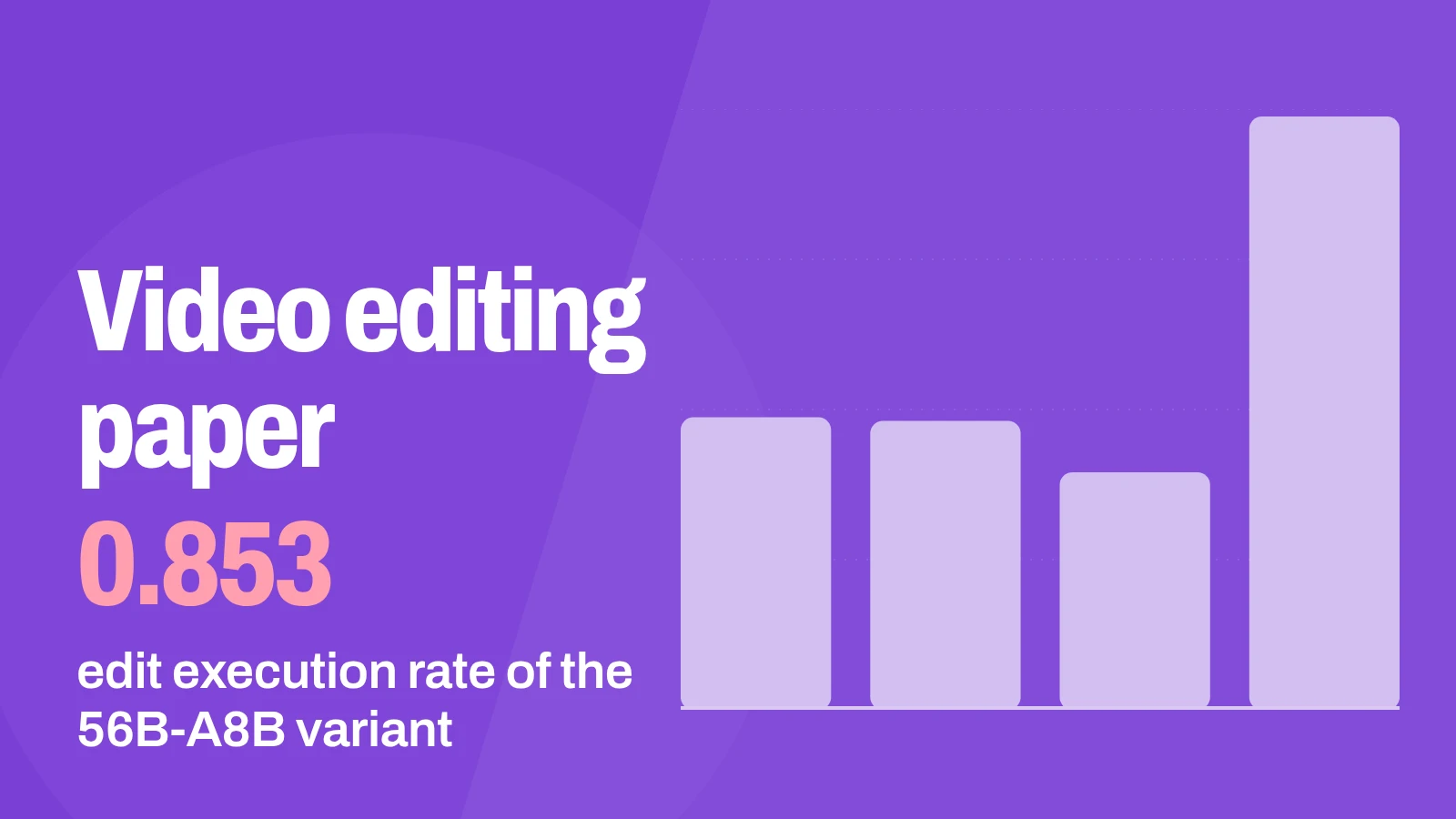
In the VideoEditor-MoE paper on arXiv, the 56B-A8B variant ranks first on averaged benchmarks with a 0.853 edit execution rate, ahead of the 14B-A8B variant at 0.837 and an MoE-MLP baseline at 0.810 (arXiv). The paper also says that every expert stays active and that the learned routing follows sample content and diffusion noise level more than human-defined editing categories (arXiv). For someone choosing an editing model, the paper pairs these scores with a compute claim: both variants require 95 TFLOPs, so the larger expert pool does not raise that cost.
Shared queries, routed key-value experts
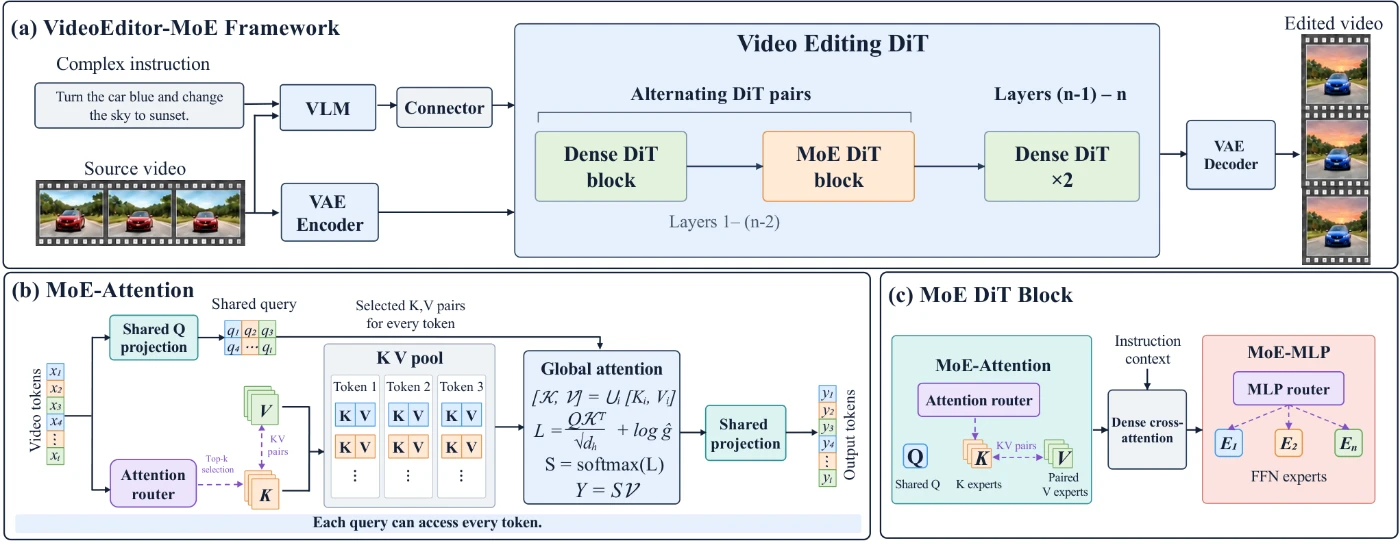
The paper presents VideoEditor-MoE as the first open-source mixture-of-experts framework for video editing. It starts from a 5B video editing model and scales to 14B and 56B parameters, with approximately 8B parameters activated per token in both variants. Its attention design, MoE-Attention, combines shared queries with routed, paired key–value experts.
The authors describe an ablation baseline, MoE-MLP, that ranks third on both editing metrics, and they say its gap to VideoEditor-MoE shows the value of MoE-Attention. The design choice is therefore tested against a variant that routes the feed-forward layers instead of attention.
Averaged scores against the existing editors
| Metric | Existing methods: MiniMax- H3 | Existing methods: CoinVE- Edit | MoE baselines: MoE-MLP (19B-A8B) | Ours: 14B-A8B | Ours: 56B-A8B |
|---|---|---|---|---|---|
| Edit Execution Rate ↑ | 0.736 | 0.779 | 0.810 | 0.837 | 0.853 |
| Edit Fulfillment ↑ | 0.727 | 0.778 | 0.813 | 0.834 | 0.851 |
| Video Quality ↑ | 0.598 | 0.677 | 0.683 | 0.704 | 0.727 |
| FVD/1000 ↓ | 1.493 | 1.095 | 1.268 | 1.193 | 1.025 |
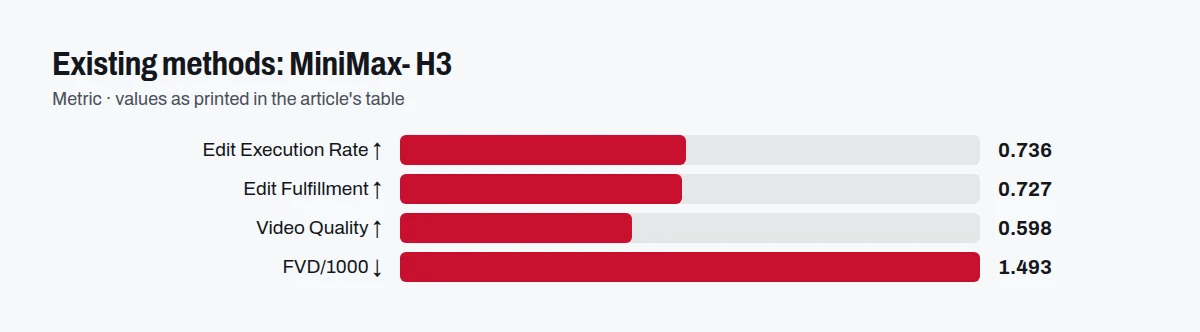
The paper averages scores over three benchmarks, OpenVE-Bench, CoinVE-Bench and CoVE-Bench, and measures edit execution rate, edit fulfillment, video quality and FVD. According to the authors, VideoEditor-MoE-56B-A8B scores highest on all metrics, the 14B-A8B variant follows, and both beat the six baselines on edit execution, edit fulfillment and video quality. The Table 1 caption says the models keep competitive FVD, and in the table the 56B-A8B variant has the lowest FVD/1000 at 1.025. Among the existing editors shown in the table, CoinVE-Edit is the strongest on edit execution rate at 0.779, which is below the 0.837 of the 14B-A8B variant. Among the existing methods in Table 1, CoinVE-Edit has the best video quality at 0.677 and the lowest FVD/1000 at 1.095, though the MoE-MLP baseline reaches 0.683 on video quality. MiniMax-H3 sits at 0.736 on edit execution and 0.727 on edit fulfillment, below CoinVE-Edit’s 0.779 and 0.778 on those two measures.
Compute cost and the hardware the repository lists
The paper says that, with optimized inference, computation scales roughly with activated rather than total parameters, and that expanding the expert pool from 14B to 56B leaves TFLOPs unchanged. Against MiniMax-H3 (24B) and CoinVE-Edit (14B), it says VideoEditor-MoE-56B-A8B requires 22–31× fewer TFLOPs and 23–31× less time.
The code page lists the 56B default inference script on 2 x 80 GB GPUs, at 46 s, with 120 GB while loading (GitHub). For videoeditor-14b, a low-memory mode runs on one 40 GB GPU in about 35 s per video. The paper’s equal 95 TFLOPs for both variants is a per-denoising-step figure, and the repository lists the default 56B script on two 80 GB GPUs, while the 14B model runs on one 80 GB GPU by default or one 40 GB GPU in low-memory mode. A team with a single 40 GB GPU can therefore plan around the 14B-A8B variant, whose 0.837 edit execution rate is second in the table. The weight repositories are gated, and access is requested on the model page.
What the averaged ranking rests on
The ranking rests on scores averaged over three benchmarks, with per-benchmark detail placed in the supplementary material, and the figures are the authors’ own. The efficiency comparison is tied to the paper’s optimized inference and is stated against MiniMax-H3 and CoinVE-Edit. The routing analysis reports that all experts remain active, which supports the claim that the extra capacity is used.
Related coverage: Motion-aware reward model cuts motion-suppressed edit picks to 0%, authors report.
Follow and ask
Add to Preferred Sources on Google
Summarise with AI:ChatGPTClaudePerplexityGoogle AI
How we built this
Published resultsTable 1 of the paper: Quantitative comparison
Rows of Table 1 of the paper (arXiv HTML version), copied cell for cell by our code; a two-row header is shown as "group: column"; an empty name cell repeats the name above it. These are the authors' own figures, not an independent test. The table has 9 columns; 6 shown, with every column that holds a figure this article gives or a measure it names. Not shown: Existing methods: 2 more columns, MoE baselines: 1 more column.
Sources
The sources this article was written from. Links open the original page.