Even the best of seven video editing models reproduces only about one seventh of the physical change an edit causes, according to the PhyCoVE benchmark for physical counterfactual video editing (arXiv). For anyone choosing an editor for edits that must obey physics, such as changing how a fluid or an elastic object moves, the paper’s scores suggest that following the edit remains weak even in the leading commercial models (arXiv).
533 cases across rigid, elastic and fluid motion
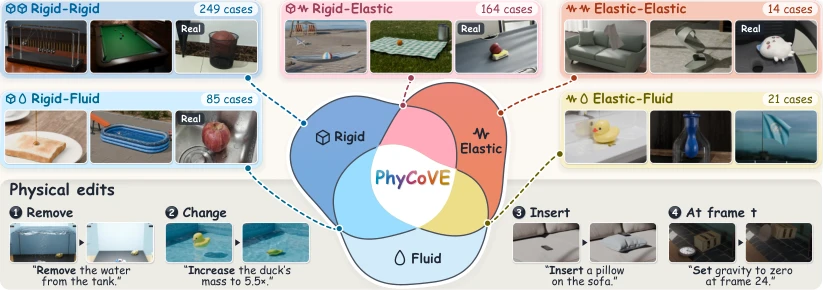
PhyCoVE, as its authors introduce it, contains 533 cases built on 110 source videos, covering rigid, elastic and fluid dynamics in five interaction patterns. The simulated part of the benchmark consists of 508 accepted cases in 90 source groups. The dataset page on Hugging Face lists videos at 1,280 by 720 pixels and 96 frames, at 24 fps (Hugging Face).
The paper also runs a blind pairwise study in which annotators see the instruction, the source and target videos and the anonymous outputs of two models, then pick the one that completes the edit better or call a tie. Each comparison pits two models on one case.
MiniMax H3 leads on CF and EA, yet scores only 2.20 on EA
In the table below, each row gives “Table block”, “Model”, “Physical metrics: CF ↑”, “Physical metrics: EA ↑”, “Physical metrics: PC ↑”, “Physical metrics: Joint ↑”, “Source page”.
| Table block | Model | Physical metrics: CF ↑ | Physical metrics: EA ↑ | Physical metrics: PC ↑ | Physical metrics: Joint ↑ |
|---|---|---|---|---|---|
| Open-source | JoyAI | 0.100 | 1.86 | 4.15 | 7.7 |
| Open-source | Kiwi-Edit | - 0.005 | 1.86 | 4.03 | 6.0 |
| Open-source | OmniWeaving | - 0.182 | 1.56 | 4.05 | 2.8 |
| Commercial | Kling 4.0 | 0.107 | 1.88 | 4.41 | 8.3 |
| Commercial | MiniMax H3 | 0.134 | 2.20 | 4.39 | 11.1 |
| Commercial | Seedance 2.5 | 0.126 | 2.07 | 4.42 | 12.0 |
| Commercial | Wan 3.0 | 0.113 | 1.99 | 4.41 | 9.9 |
| Commercial | No edit | 0.000 | – | – | – |
| Commercial | τ with HPWR | 0.90 | 0.90 | 0.62 | 1.00 |
| Commercial | ρ with HPWR | 0.96 | 0.96 | 0.82 | 1.00 |
According to the paper, the judge rates all seven models as physically plausible, with a PC above 4, but finds they rarely follow the edit, with an EA of at most 2.20. The commercial models take the first three places on CF and EA, namely MiniMax H3, Seedance 2.5 and Wan 3.0, while JoyAI leads the open-source models on CF. Kiwi-Edit and OmniWeaving obtain a negative CF. The benchmark’s repository table gives MiniMax H3 the highest CF at 0.134 and the highest EA at 2.20 (GitHub).
The gap between PC and EA is the central pattern: Kling 4.0 reaches a PC of 4.41 but an EA of only 1.88, so a plausible-looking clip is not evidence that the requested change happened. Seedance 2.5 has the best Joint score at 12.0 even though MiniMax H3 leads CF and EA, so the ranking depends on which measure a user cares about. On Joint, the open-source models score 7.7 for JoyAI, 6.0 for Kiwi-Edit and 2.8 for OmniWeaving, while Kling 4.0 reaches 8.3 and Wan 3.0 reaches 9.9.
Commercial editors lead on real clips, but a simulator reaches 0.481
The commercial-over-open-source order on CF and EA also holds on the real set, not only on the whole benchmark. The picture changes on specific edit types and methods. On changes of physical quantity, the best CF is 0.019, and 79% of videos stay near the source dynamics, according to the repository. VideoPhysEdit, which edits by simulating the change in a scene reconstructed from the source video, reaches a CF of 0.481 on 10 simulated classic rigid-body cases, whereas none of the seven models exceeds 0.145.
Set beside the repository’s 0.134 for MiniMax H3, the paper’s 0.145 ceiling on those rigid-body cases shows that the generative editors stay far below an explicit simulation route, at least on that narrow subset of 10 cases. The human preference study covers pairwise comparisons of models on single cases, so its coverage is bounded by those comparisons.
Licence terms and what the scores mean for a choice
The code repository is MIT licensed, and the dataset card on Hugging Face declares the MIT licence too (Hugging Face). Third-party assets in the repository keep their original licences. Anyone reusing the videos should therefore check the asset records before shipping them in a product.
For a team choosing between a commercial editor and an open-source one for physical edits, the numbers favour the commercial side: Wan 3.0 scores a CF of 0.113 and an EA of 1.99, against 0.100 and 1.86 for JoyAI. The margin is small, and none of the models comes near reproducing the full physical change, so edits that depend on exact physics still call for manual checks or a simulation step.
Related coverage: PhysResponse benchmark: ten video models miss physical parameters, authors report.
Follow and ask
Add to Preferred Sources on Google
Summarise with AI:ChatGPTClaudePerplexityGoogle AI
Where to try it
From the source: raw.githubusercontent.com/Hammour-steak/PhyCoVE/HEAD/README.md.
ManyMotions lists Seedance 2.5 among its video models. Seedance 2.5 on ManyMotions
How we built this
Published resultsTable 2 of the paper: Results on PhyCoVE
Rows of Table 2 of the paper (arXiv HTML version), copied cell for cell by our code; a two-row header is shown as "group: column"; an empty name cell repeats the name above it. These are the authors' own figures, not an independent test. The first column is the block of the table the row sits in. The table has 11 columns; 5 shown: the Physical metrics columns, the ones the paper's text citing the table reports on. Not shown: Human, Physical metrics: 1 more column, Visual fidelity (4 columns).
Sources
The sources this article was written from. Links open the original page.
- arXivPhyCoVE: Benchmarking Physical Counterfactual Video Editing across Diverse Material Dynamicsarxiv.org
- arXivPhyCoVE: Benchmarking Physical Counterfactual Video Editing across Diverse Material Dynamicsarxiv.org
- GitHubhttps://github.com/Hammour-steak/PhyCoVE: page linked by the paper as its resourceraw.githubusercontent.com
- Hugging Facehttps://huggingface.co/datasets/ccmoony/PhyCoVE: page linked by the paper as its resourcehuggingface.co
- Hugging FaceLicence declared in the front matter of the dataset card ccmoony/PhyCoVE on Hugging Face, linked by https://arxiv.org/abs/2611.29184huggingface.co
- ManyMotionsManyMotions: Seedancemanymotions.com