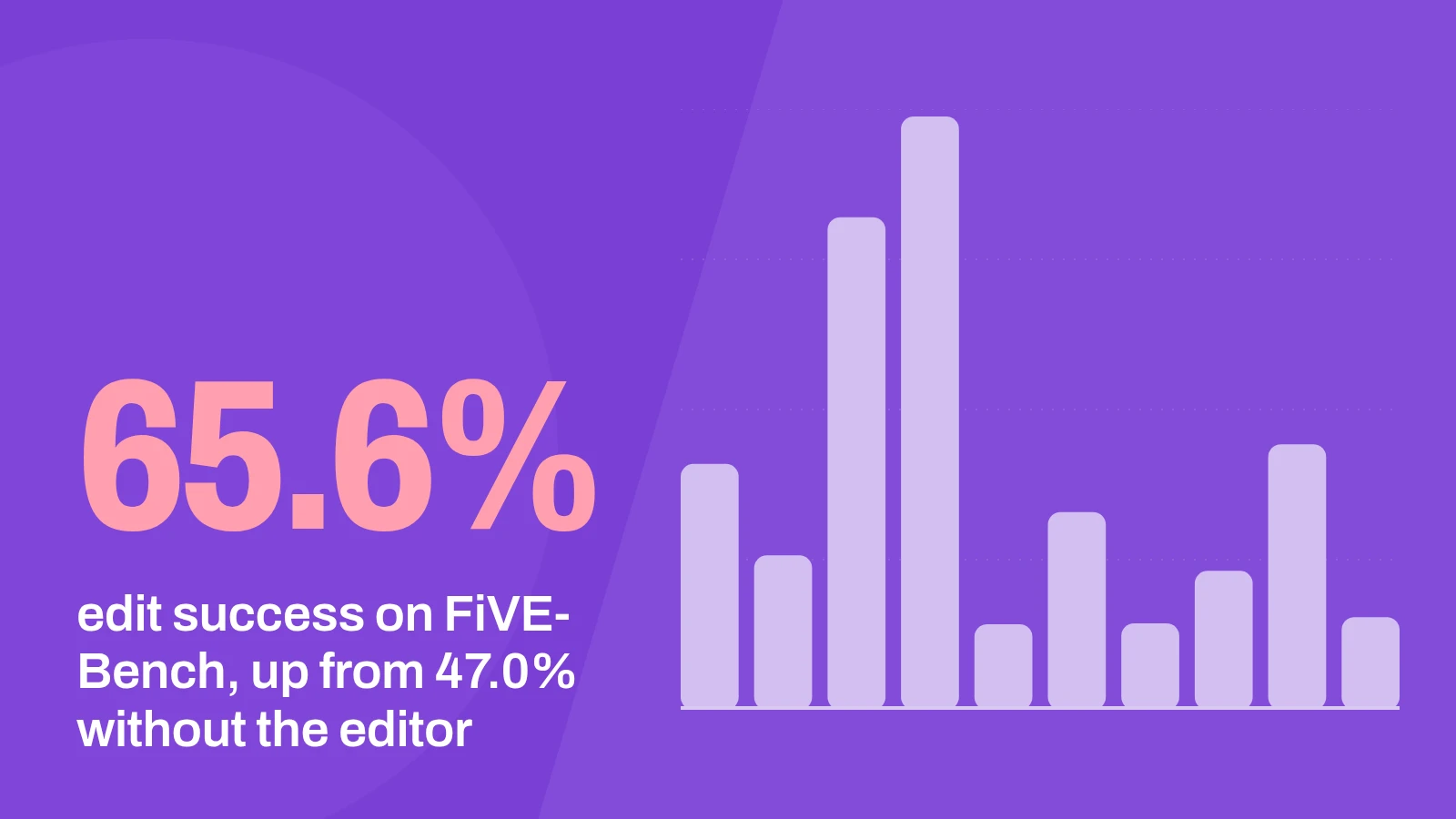
TOGO, described in an arXiv paper, turns an instruction-based image editor into a video editor without any training, according to its authors (arXiv). On FiVE-Bench the method raises edit success from 47.0% (the same video model without the editor) to 65.6%, above the best published method at 59.2%. For anyone who already runs Wan2.1, the claim is that a stronger image editor can be plugged in at sampling time instead of fine-tuning a video model.
Two weak workarounds and the velocity trick
The paper starts from two known workarounds. Applying an image editor to every frame flickers, because the editor has no notion of time (arXiv). Editing only the first frame and propagating it with an image-to-video model avoids flicker but often loses the edit; the authors report that it succeeds on only 38% of FiVE-Bench edits.
TOGO takes the difference between the editor’s velocity under the instruction and under a neutral prompt, which the authors call the edit velocity, and adds it to the sampler of a video model. Added naively, this blurs the video, alters the background and flickers, so the method needs more than a plain sum. The authors combine Qwen-Image-Edit with the Wan2.1 video model, with no training or fine-tuning.
Edit success against nine baselines
In the table below, each row gives “Method”, “Structure: Struct ↓”, “Motion: MFS ↑”, “Edit success: FiVE-Acc ↑”, “Edit success: Acc _2↑”, “Source page”.
| Method | Structure: Struct ↓ | Motion: MFS ↑ | Edit success: FiVE-Acc ↑ | Edit success: Acc _2↑ |
|---|---|---|---|---|
| TokenFlow | 35.62 | 89.00 | 27.43 | 31.32 |
| VidToMe | 22.37 | 90.06 | 26.77 | 29.29 |
| AnyV2V | 71.36 | 60.36 | 38.02 | 35.14 |
| DMT | 85.95 | 82.30 | 48.42 | 44.30 |
| VideoGrain | 12.40 | 88.57 | 37.23 | 49.77 |
| Pyramid-Edit | 28.65 | 80.59 | 43.84 | 45.44 |
| Wan-Edit | 12.53 | 89.43 | 46.97 | 46.03 |
| FlowDirector | 20.13 | 87.89 | 56.38 | 54.13 |
| VACE | 38.46 | 83.26 | 59.17 | 60.11 |
| TOGO (ours) | 13.42 | 88.83 | 65.60 | 60.45 |
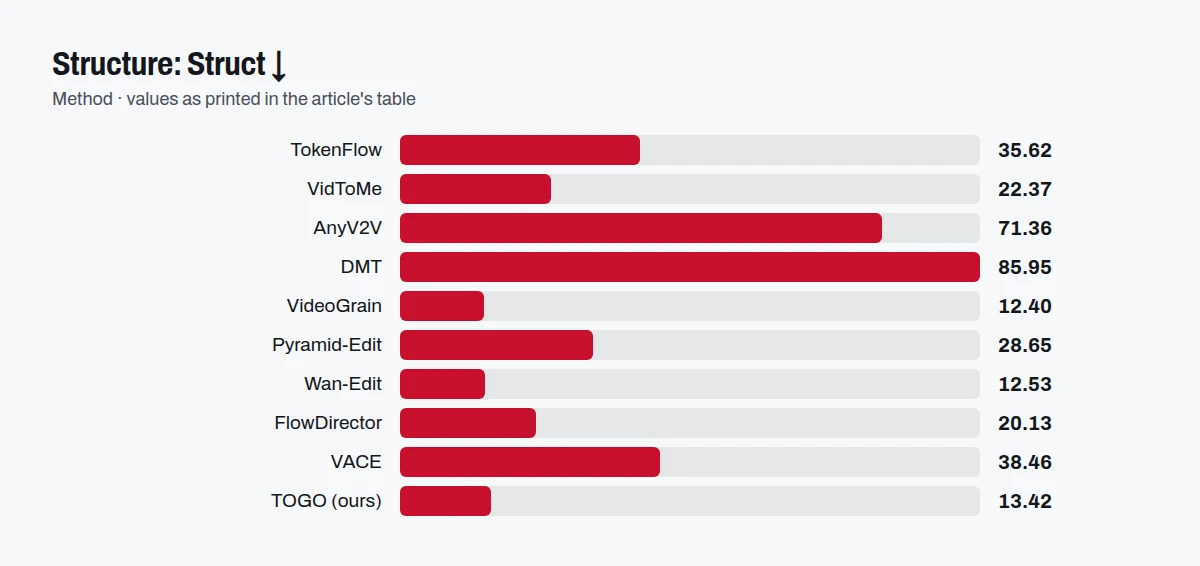
Under the official FiVE-Bench judge, TOGO reaches a FiVE-Acc of 65.6, which the authors put 6.4 points above VACE, 9.2 above FlowDirector and 18.6 above Wan-Edit. VACE is trained on video data, while Wan-Edit edits the same backbone without the edit velocity. The 59.2% best published method in the abstract is consistent with the VACE row, so the margin over the strongest trained rival is real in the authors’ own numbers but modest. Structure distance is where TOGO is not first: VideoGrain scores 12.40 and Wan-Edit 12.53, against 13.42 for TOGO, with lower being better. VideoGrain’s FiVE-Acc is only 37.23, so its tidy structure comes with many failed edits. On motion fidelity TOGO’s 88.83 sits just below Wan-Edit’s 89.43, while VidToMe reaches 90.06 with a FiVE-Acc of only 26.77.
A second judge and a sampler-only check
TOGO again ranks first at 60.5, on par with VACE at 60.1 and well ahead of FlowDirector at 54.1 and Wan-Edit at 46.0. The VACE gap shrinks to a near tie under this second judge, so the lead over VACE depends on which judge is used.
The authors also say the sampler alone reaches only 41.9, so the gain comes from the editor and not from the sampler settings. Swapping in other editors or other video models, without retuning, improves FiVE-Acc by +15.6 to +28.1 points over the same video model without an editor.
Short clips, one resolution and the cost of pushing harder
The evaluation uses 100 videos with 419 edit pairs in six categories, taking the first 41 frames at 832× 480. The default configuration, built on Wan2.1 with Qwen-Image-Edit, uses a 50-step schedule with timestep shift 3 and CFG scales of 3 for the source and 7 for the target. The result is therefore shown on short clips at one resolution.
The ablation shows the cost of pushing harder: the amplifier alone gives the highest FiVE-Acc at 74.2, but motion fidelity falls from 89.5 to 78.9. Someone choosing between edit strength and preserving the source motion should treat that variant as a warning, because the full method’s 65.6 keeps motion fidelity at 88.83 in the table.
Not in the sources: hardware requirements
We check six facts on every story in the full text of each source. The pages listed under Sources do not state hardware requirements.
Related coverage: RecastAgent beats rewriting baselines on Bernini and Ditto, paper says.
Follow and ask
Add to Preferred Sources on Google
Summarise with AI:ChatGPTClaudePerplexityGoogle AI
How we built this
Published resultsTable 1 of the paper: Comparison on FiVE-Bench
Rows of Table 1 of the paper (arXiv HTML version), copied cell for cell by our code; a two-row header is shown as "group: column"; an empty name cell repeats the name above it. These are the authors' own figures, not an independent test. The table has 11 columns; 5 shown: the Structure and Motion and Edit success columns, the ones the paper's text citing the table reports on. Not shown: Background preservation (3 columns), Text alignment (2 columns), Speed.
Sources
The sources this article was written from. Links open the original page.