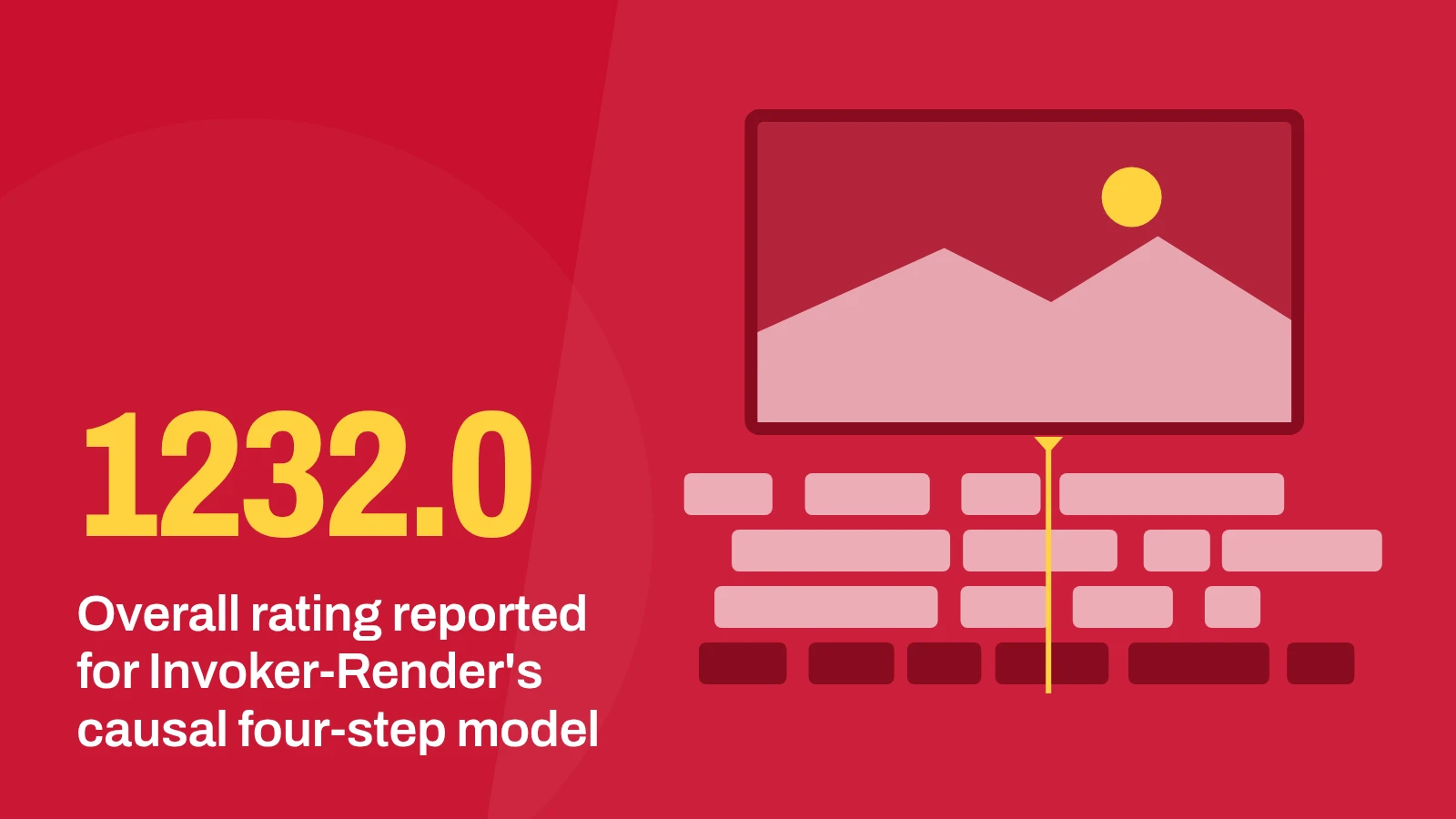
Invoker-Render, the system in the Code World Model 2.0 paper, ranks first on all four criteria against recent streaming baselines, with an Overall rating of 1232.0 (arXiv). The paper also reports stable 30-minute racing rollouts that preserve scene and subject appearance (arXiv). The design pairs a creation model with a fast causal one that can run as a stream.
Two models behind one control interface
According to the Code World Model 2.0 paper, Invoker-Render pairs a bidirectional creation model with a causal four-step streaming model. Both models share one conditioning interface built on structural proxies, an appearance reference and language. In practice this means a user can steer a generated scene through several kinds of input at once, rather than through a text prompt alone.
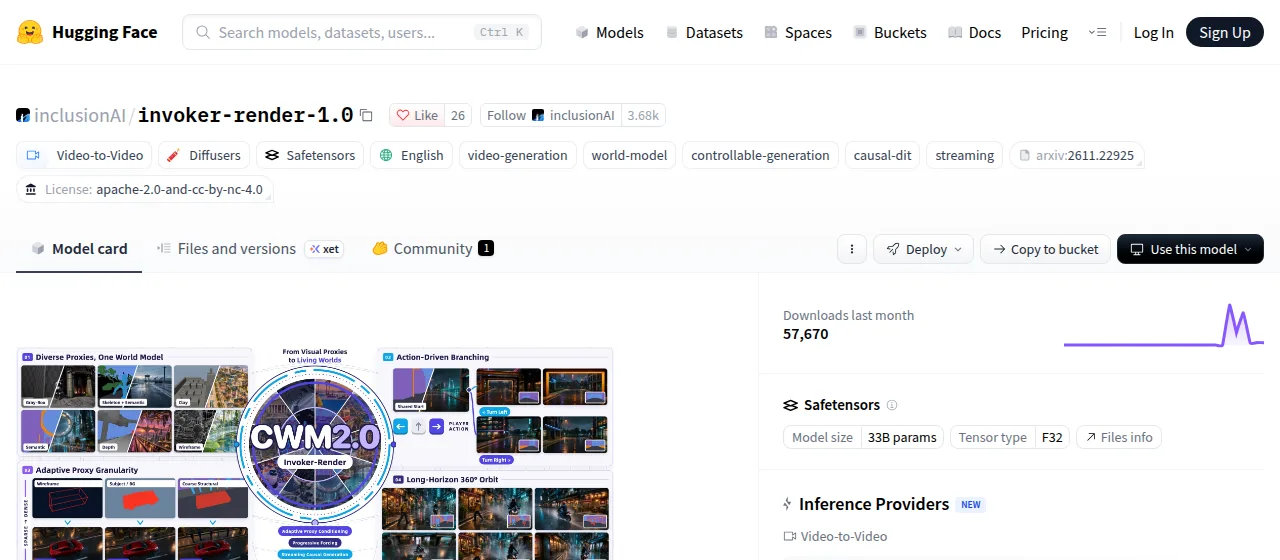
The authors summarise their experiments as showing versatile control across proxy families, granularities and camera paths. They also report consistent gains over recent streaming baselines.
Planning a whole clip versus acting frame by frame
In the creation setting, the paper describes people revising entire proxy sequences, adjusting where the camera goes, how subjects move and when events happen. The bidirectional model looks at the whole clip at once. When a video is streamed, what comes next hinges on actions that have not yet happened.
That split explains why two models are needed: a model that sees the whole clip can polish a planned sequence, while a streaming model must commit to frames before the next action arrives. The paper says users edit complete proxy sequences for creation, while the causal model takes in proxy chunks step by step during streaming, and both models share an interface that accepts coarse and fine proxies.
Which model holds the 1232.0 rating
The headline result is a first-place ranking on all four criteria, with an Overall rating of 1232.0, according to the paper. In the paper’s comparison table, that rating belongs to the causal four-step model, listed as Invoker-Render (Causal, Ours). The same row for that 4-step model lists 1236.4, 1209.0 and 1164.1 alongside the 1232.0 figure. The ranking comes from the developers’ own paper, so it remains a developer-side claim until others reproduce it.
The reported long-horizon test is a racing rollout of 30 minutes that, per the authors, stays stable and keeps scene and subject appearance. Because the repository says the 30-minute racing demo used a reference-guided quality policy that the default service leaves off, the long-rollout claim looks harder to check with default settings (GitHub).
Released pieces and licence conditions
The GitHub repository’s release status marks inference code, a deployment guide and model weights as published. The training method and data remain unpublished, according to the same checklist. The licence or terms of use linked from the model page carry a commercial-use restriction and a further condition, so anyone planning production work should read them first (Hugging Face, GitHub).
The paper and the repository checklist complement each other: the paper describes the system and its results, while the checklist shows which parts a team can actually run.
Choosing between creation and streaming use
Streaming generation with a four-step causal model targets interactive use, where frames must keep arriving under user control. Because the bidirectional model serves video creation and the causal four-step model serves streaming, with one shared conditioning interface, the same inputs can plausibly drive both stages. Whether the Overall rating of 1232.0 holds up on other content and against newer baselines is something independent evaluations would need to show.
Related coverage: LynnReal-Hand: hand-controlled video world model, with a fast VAE decoder.
Follow and ask
Add to Preferred Sources on Google
Summarise with AI:ChatGPTClaudePerplexityGoogle AI
Sources
The sources this article was written from. Links open the original page.
- arXivCode World Model 2.0: Towards Infinite Controllable Video Generationarxiv.org
- arXivCode World Model 2.0: Towards Infinite Controllable Video Generationarxiv.org
- GitHubhttps://github.com/inclusionAI/CodeWorldModel: page linked by the paper as its resourceraw.githubusercontent.com
- Hugging Facehttps://huggingface.co/inclusionAI/invoker-render-1.0: page linked by the paper as its resourcehuggingface.co
- GitHubLicence or terms of use linked by https://huggingface.co/inclusionAI/invoker-render-1.0github.com