Refrain, a multi-shot video model described in an arXiv paper, reaches a style-consistency score (SDC) of 0.315 and a transition MAE of 0.199s on the authors’ benchmark, the highest style consistency among the methods compared (arXiv). It is built on an 8.49B-parameter HunyuanVideo-1.5 DiT, yet the repository README says the Refrain DiT and VAE are not released and the repository has no licence file, so a reader gets training code and an evaluation toolkit rather than a model to run (GitHub, GitHub).
Training on references that disagree with each other
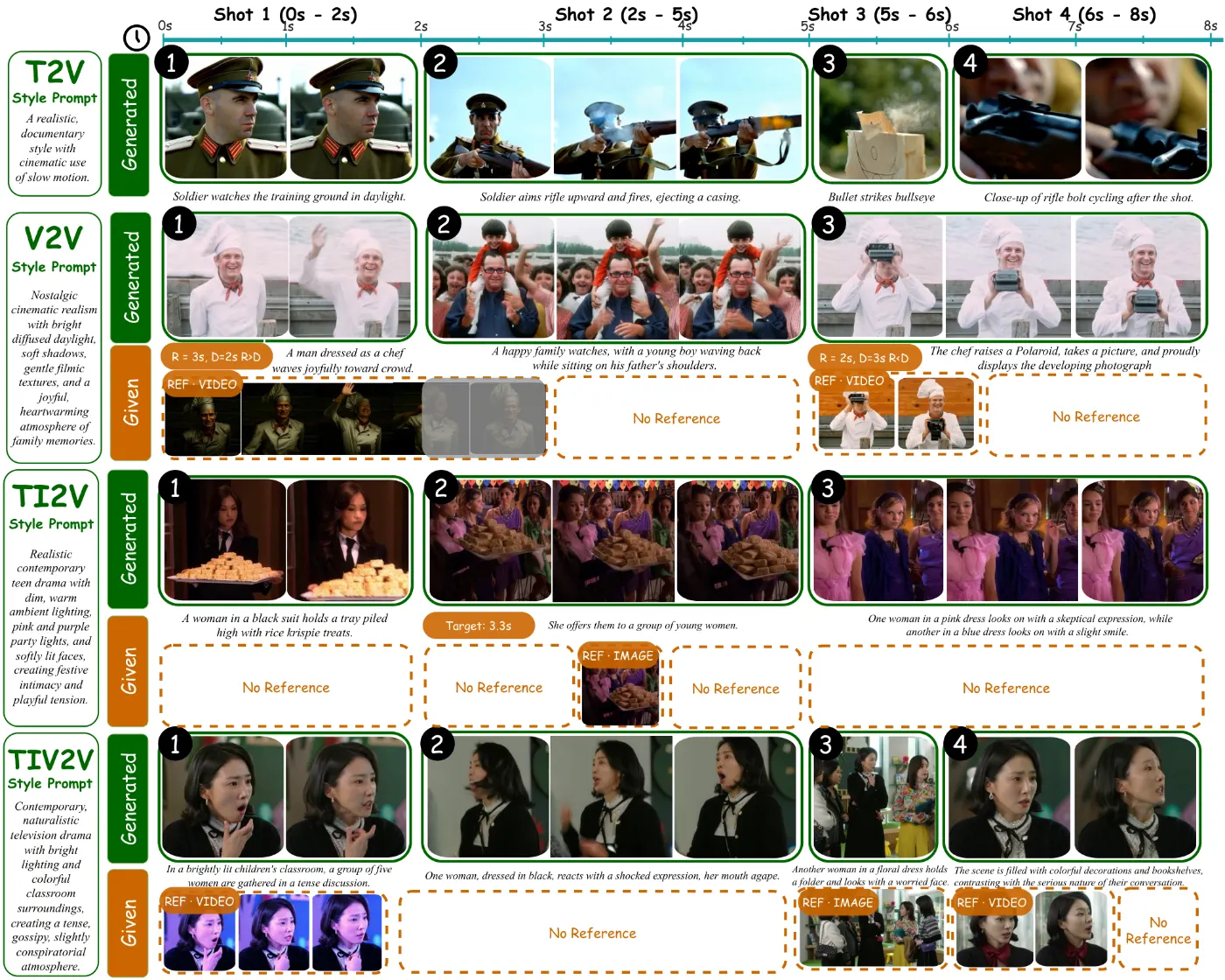
The paper presents Refrain as one model that picks up consistency across shots by solving a self-supervised reconstruction task (arXiv). Its data pipeline produces DurMix-300K, a set that pairs independently edited references of different durations with the videos they came from. According to the paper, the set contains more than 300,000 reference conditions built from 61 edit instructions grouped in eight categories. The idea is that the model sees references whose styles conflict and must still reconstruct one coherent video, rather than learning from references that already match. In an ablation on independently edited test references, independent-edit training raised SDC from 0.301 to 0.315 compared with shared-edit training.
Style and timing against the compared methods
The paper states that Refrain leads the baselines in visual consistency, reference adherence and temporal precision. Under test references with deliberate style conflicts, it reaches SDC 0.315. Refrain generates all shots in one diffusion trajectory, and the authors give a transition MAE of 0.199s for it. Boundary timing depends on a specific component: in the authors’ ablation, removing the shot-aware RoPE offsets raises transition error from 0.199s to 0.281s.
Table 2 on size and cost: 8.49B and 324.4 P against heavier baselines
In the table below, each row gives “Method”, “#Params (B)”, “FLOPs (P) ↓”, “Generation and Alignment: MAE s ↓”, “Generation and Alignment: SDC ↑”, “Source page”.
| Method | #Params (B) | FLOPs (P) ↓ | Generation and Alignment: MAE s ↓ | Generation and Alignment: SDC ↑ |
|---|---|---|---|---|
| HunyuanVideo1.5 | 8.49 | 324.4 | 0.802 | 0.090 |
| Phantom | 14.29 | 648.7 | ✗ | 0.130 |
| RefAlign | 14.29 | 807.7 | ✗ | 0.125 |
| StoryMem | 29.80 | 493.2 | ✗ | 0.175 |
| VACE | 17.34 | 608.9 | ✗ | 0.108 |
| Refrain (ours) | 8.49 | 324.4 | 0.199 | 0.315 |
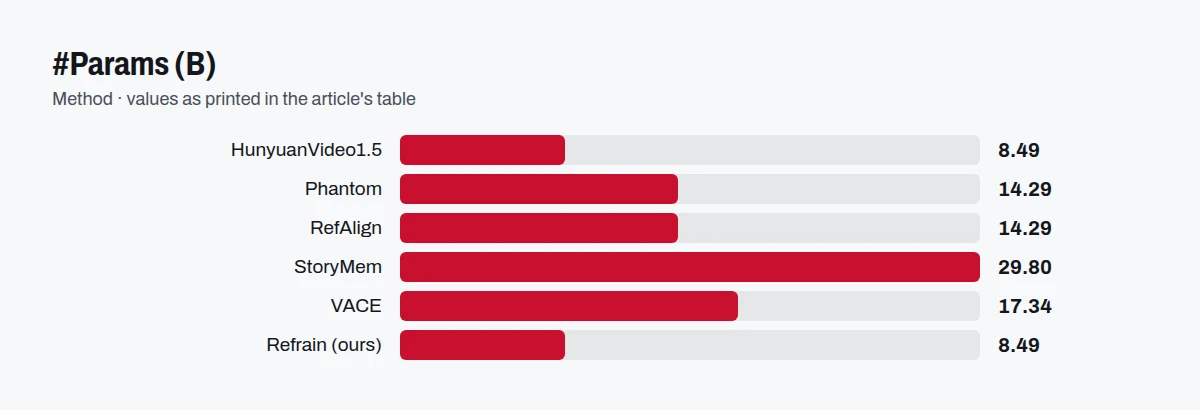
Phantom has 14.29 B parameters and 648.7 P FLOPs, and StoryMem has 29.80 B parameters and 493.2 P FLOPs. Against these cells, Refrain’s SDC of 0.315 does not come from a larger model, since it has the smallest parameter count of the rows listed. The paper defines these FLOPs as analytical denoising estimates for a 480×832, 241-frame video with three shots and three 49-frame references, leaving out encoders and VAE decoding.
Limits of the score and what the repository gives you
The real target videos of the benchmark reach SDC 0.332, so Refrain’s 0.315 sits below the real-video level on the same calibration bank. Table 2 also marks some cells as inapplicable: methods whose boundaries come from shot concatenation carry no transition MAE entry. Timing precision is therefore compared only with methods that choose their own cuts. The repository releases training and inference code, the evaluation toolkit and the SDC calibration bank, while the Refrain DiT and VAE are withheld, so generation needs compatible weights of your own. The repository also carries no licence file.
Related coverage: CaT-Movie reports 0.974 cut execution on CaT-MBench with a planner plus window renderer.
Follow and ask
Add to Preferred Sources on Google
Summarise with AI:ChatGPTClaudePerplexityGoogle AI
How we built this
Published resultsTable 2 of the paper: Unified multi-shot generation
Rows of Table 2 of the paper (arXiv HTML version), copied cell for cell by our code; a two-row header is shown as "group: column"; an empty name cell repeats the name above it. These are the authors' own figures, not an independent test. The table has 13 columns; 5 shown, with every column that holds a figure this article gives or a measure it names. Not shown: Generation and Alignment: 2 more columns, Inter-Shot ↑ (3 columns), Reference ↑ (3 columns).
Sources
The sources this article was written from. Links open the original page.
- arXivRefrain: Learning Multi-Shot Consistency from Inconsistent References for A$^2$O Video Generationarxiv.org
- arXivRefrain: Learning Multi-Shot Consistency from Inconsistent References for A$^2$O Video Generationarxiv.org
- GitHubhttps://github.com/Tencent-Hunyuan/Refrain: page linked by the paper as its resourceraw.githubusercontent.com
- GitHubLicence of the repository Tencent-Hunyuan/Refrain on GitHub: noneapi.github.com