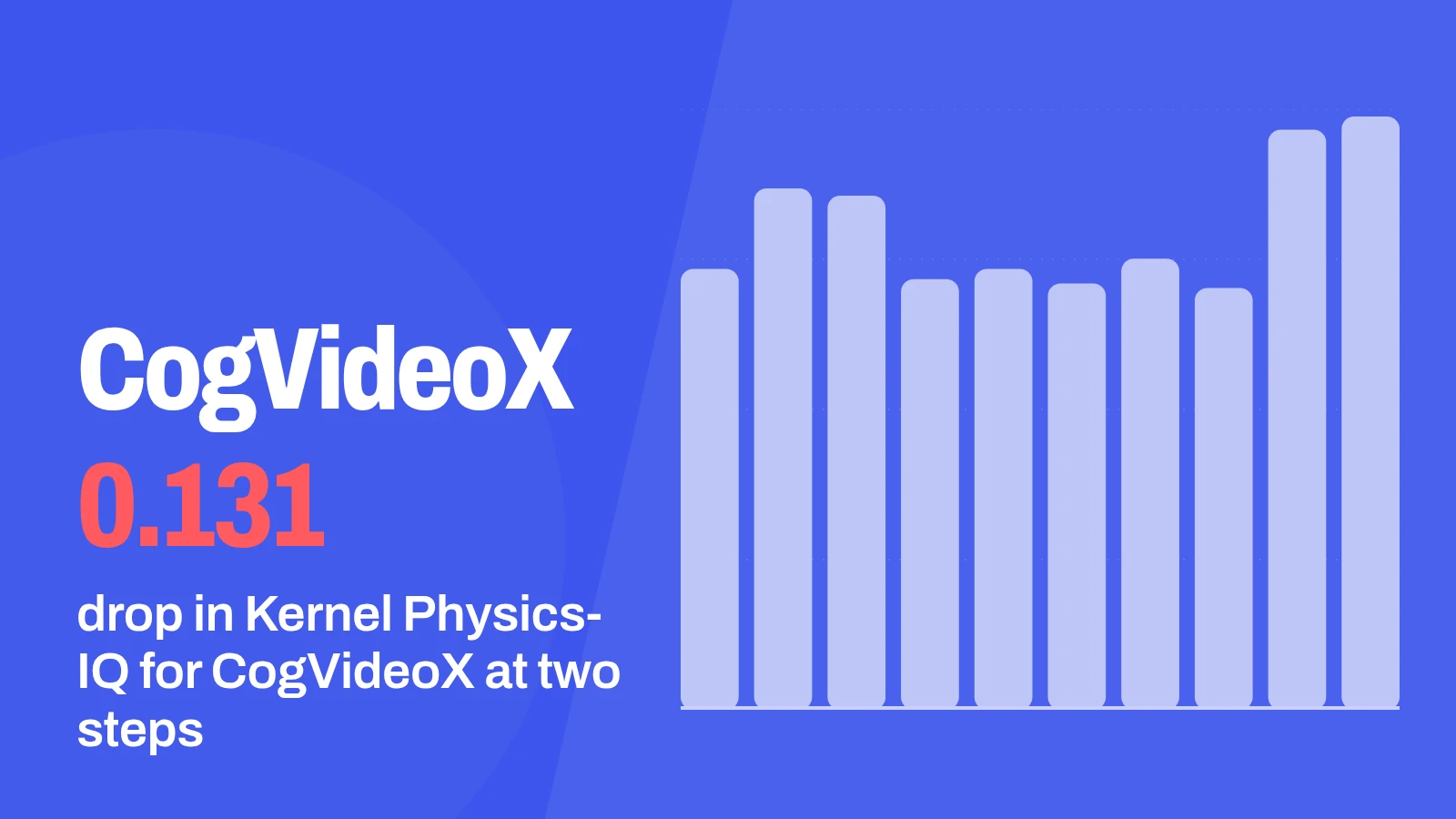
An arXiv paper reports that cutting image-to-video sampling to two denoising steps lowers a new metric, Kernel Physics-IQ, in all five models it tests (arXiv). For CogVideoX, the official Physics-IQ score rises by 0.055 while Kernel Physics-IQ falls by 0.131 (arXiv). Anyone choosing a step count, or ranking models by the official physics score, should treat a gain from fewer steps with suspicion, since the authors argue the score can reward reduced variation instead of better physics.
A benchmark that pays for samples that look alike
The paper’s argument is that a physics benchmark scored on a single sample per condition cannot tell a better model from one that simply varies less between runs. The authors introduce Kernel Physics-IQ to remove that incentive in expectation, and it needs only two independent samples per condition. Their term for the unearned gain is a dispersion premium: the official score collects it when outputs cluster tightly, and the kernel version does not.
On CogVideoX, according to the paper, a 0.200 dispersion premium outweighs a 0.145 kernel loss, which yields a detected +0.055 official gain. Over the same change, Kernel Physics-IQ drops by 0.131.
Table 1: the official score and the kernel score move apart
In the table below, each row gives “Setting”, “Official ↑”, “Kernel Physics-IQ ↑”, “SSR”, “Source page”.
| Setting | Official ↑ | Kernel Physics-IQ ↑ | SSR |
|---|---|---|---|
| CogVideoX, 50 steps | 0.301 | 0.737 | 0.90 |
| CogVideoX, 2 steps | 0.356 | 0.607 | 0.29 |
| CogVideoX, LDG (50 steps) | 0.351 | 0.707 | 0.81 |
| Cosmos, 35 steps | 0.294 | 0.725 | 1.09 |
| Cosmos, 2 steps | 0.301 | 0.609 | 0.51 |
| Wan2.1, 50 steps | 0.291 | 0.746 | 1.21 |
| Wan2.1, 2 steps | 0.308 | 0.693 | 0.86 |
| Wan2.1, distilled 4 steps | 0.288 | 0.619 | 0.94 |
| Wan2.2, 50 steps | 0.396 | 0.766 | 0.87 |
| Wan2.2, 2 steps | 0.405 | 0.628 | 0.37 |
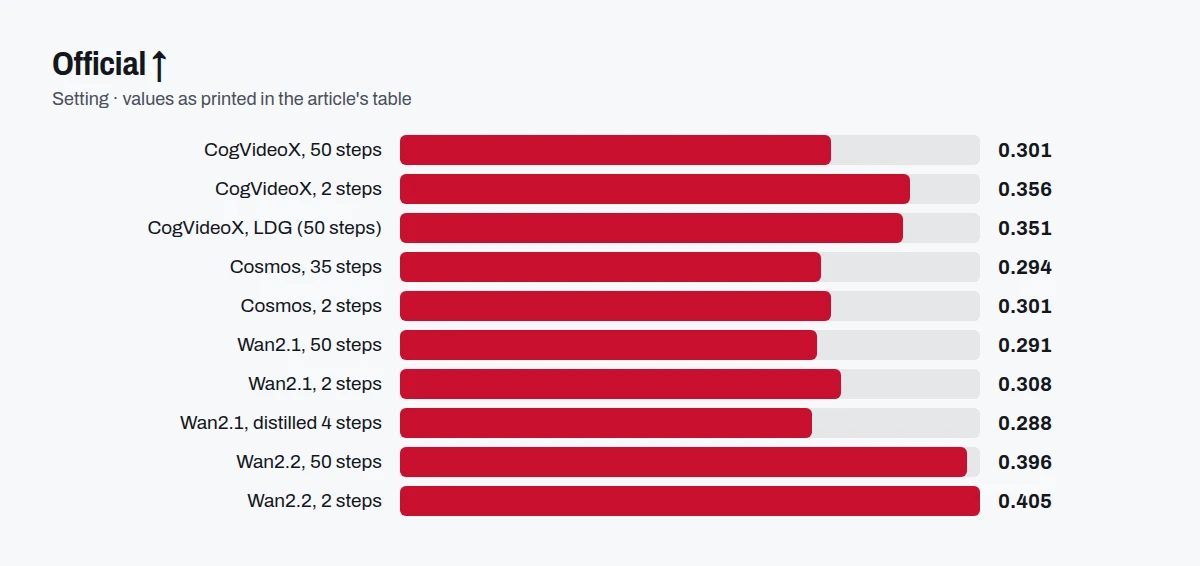
CogVideoX at 50 steps scores 0.301 on the official measure and 0.737 on Kernel Physics-IQ, with an SSR of 0.90. At 2 steps, CogVideoX reaches 0.356 officially, but its Kernel Physics-IQ is 0.607 and its SSR is 0.29. Cosmos at 35 steps scores 0.294 and 0.725; at 2 steps it scores 0.301 and 0.609. The Wan2.1 rows show a milder version, with 0.693 on the kernel measure at 2 steps against 0.746 at 50 steps, and a distilled 4-step variant at 0.619. The distilled Wan2.1 variant at 4 steps lands near the Cosmos 2-step run on the kernel measure, 0.619 against 0.609.
Guided sampling collects the same premium
The paper says PhaseLock’s guided sampler, called LDG, collects a dispersion premium as well, lifting CogVideoX officially by +0.050 while lowering Kernel Physics-IQ by 0.031. In the table, CogVideoX with LDG at 50 steps scores 0.351 officially and 0.707 on the kernel measure, with an SSR of 0.81. The authors describe PhaseLock as measuring reduced low-frequency phase coherence across steps and using a two-step prior to raise official scores across three models.
Scope of the scoring and what it means for choosing a step count
Table 1 gives center-view scores on all 66 scenes, and the paper scores a separate entry, Take 2, as a one-outcome forecast on the 52 non-duplicate pairs. The caption also notes that for HunyuanVideo the SSR falls through sample-mean error, without a detected net shrinkage. The mechanism is therefore not identical across models, and the headline result is about Kernel Physics-IQ falling, which the paper reports for all five image-to-video models.
For a team deciding whether a 2-step setting is good enough, the CogVideoX rows are the warning: an official score of 0.356 beats 0.301, yet the kernel score of 0.607 trails 0.737. A leaderboard built on the official measure alone would pick the faster setting, while the kernel measure would pick 50 steps.
Not in the sources: hardware requirements
We check six facts on every story in the full text of each source. The pages listed under Sources do not state hardware requirements.
Related coverage: PhysResponse benchmark: ten video models miss physical parameters, authors report.
Follow and ask
Add to Preferred Sources on Google
Summarise with AI:ChatGPTClaudePerplexityGoogle AI
Where to try it
MegaScenes lists Kling 3.0 Standard, Veo 3.1 Fast and Seedance 1.0 Pro Fast for image to video. Image to video on MegaScenes
How we built this
Published resultsTable 1 of the paper: Two steps lower Kernel Physics-IQ for every model
Rows of Table 1 of the paper (arXiv HTML version), copied cell for cell by our code; a two-row header is shown as "group: column"; an empty name cell repeats the name above it. These are the authors' own figures, not an independent test. Rows: the first 10 of 13.
Sources
The sources this article was written from. Links open the original page.