VivaWorld, an arXiv paper on generating long videos from a single image, reports that its method cuts long-video rotation and translation errors by 23.4% and 38.8% compared with Lyra2, the strongest baseline (arXiv). The paper also states that it reaches state-of-the-art visual quality and camera control, and that it supports controllable novel-view synthesis, long-horizon scene exploration and physical AI (arXiv). For someone picking a camera-controlled scene generator, the speed ranking matters as much as the error cut: the paper says VivaWorld is faster than Lyra2 but slower than Gen3C and AnyRecon.
One image in, a geometry-consistent long video out
The authors introduce VivaWorld as a framework that generates geometry- and view-consistent long videos starting from an image. Consistency over geometry and viewpoint is the property that tends to break when a generator is asked to continue a scene for many chunks, so the paper’s evaluation concentrates on the gap between short and long outputs. The comparison set covers six other methods: AnyRecon, Gen3C, Voyager, Lyra2, VerseCrafter and NeoVerse.
Best single-chunk fidelity, but not the best single-chunk camera score
In the table below, each row gives “Methods”, “Single-Chunk Generation: PSNR ↑”, “Single-Chunk Generation: SSIM ↑”, “Single-Chunk Generation: LPIPS ↓”, “Single-Chunk Generation: Style ↑”, “Single-Chunk Generation: Cam. ↑”, “Source page”.
| Methods | Single-Chunk Generation: PSNR ↑ | Single-Chunk Generation: SSIM ↑ | Single-Chunk Generation: LPIPS ↓ | Single-Chunk Generation: Style ↑ | Single-Chunk Generation: Cam. ↑ |
|---|---|---|---|---|---|
| AnyRecon | 18.54 | 0.436 | 0.285 | 98.67 | 94.75 |
| Gen3C | 19.92 | 0.513 | 0.254 | 98.09 | 91.61 |
| Voyager | 18.60 | 0.446 | 0.345 | 98.62 | 92.57 |
| Lyra2 | 20.01 | 0.528 | 0.227 | 98.74 | 96.34 |
| VerseCrafter | 17.24 | 0.431 | 0.292 | 97.45 | 85.53 |
| NeoVerse | 17.70 | 0.415 | 0.370 | 99.02 | 96.22 |
| Ours | 21.24 | 0.570 | 0.173 | 98.65 | 95.22 |
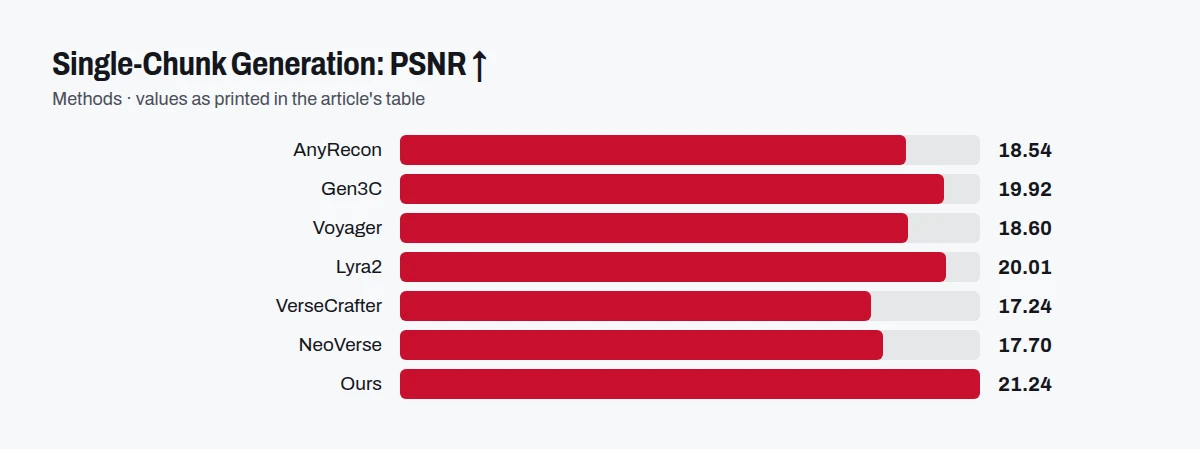
The paper’s score table is divided into single-chunk generation and long-video generation, and its caption says the baselines degrade sharply from single chunks to long videos. The caption adds that VivaWorld has the best visual fidelity in both settings and the best long-video camera control. In the single-chunk columns, VivaWorld scores a PSNR of 21.24, against 20.01 for Lyra2, the next highest. Its SSIM is 0.570 against 0.528 for Lyra2, and its LPIPS, where lower is better, is 0.173 against 0.227 for Lyra2. On the single-chunk camera score, Lyra2 reaches 96.34 and NeoVerse 96.22, while VivaWorld reaches 95.22. The single-chunk lead is therefore one of image fidelity: VivaWorld tops all three fidelity measures in the rows shown but trails two baselines on camera score. That fits the caption, which claims the camera-control win only for long videos, where the 23.4% and 38.8% error cuts against Lyra2 are reported.
The table is the authors’ work, and the long-video columns are not reproduced here, so the long-video margins rest on the paper’s stated result.
Slower than Gen3C and AnyRecon, and color still drifts
On speed, the authors say their method is faster than VerseCrafter, Lyra2, NeoVerse and Voyager, but slower than Gen3C and AnyRecon. On quality, they note that the current pipeline does not fully prevent color drift during long-horizon generation. The drift limit sits next to the headline claim: lower camera error describes where the viewpoint ends up, and it does not by itself tell you that colors stay stable over a long rollout.
Choosing between Lyra2 and VivaWorld for a scene walkthrough
A team generating long walkthroughs from one image and judging by camera accuracy has a concrete reason to test VivaWorld against Lyra2, since the paper reports 23.4% lower rotation error and 38.8% lower translation error on long videos, and says VivaWorld is also the faster of the two. A team that mainly needs short single chunks with tight camera following has less to gain, because Lyra2’s camera score of 96.34 is above VivaWorld’s 95.22 in that setting. Where throughput dominates, Gen3C and AnyRecon are faster than VivaWorld, so the accuracy gain would be paid for in generation time against those two. Color drift is the check to run on your own long scenes before adopting it, since the authors say it is not fully prevented.
Related coverage: Lyris, a layout-planned video model, cuts camera error 3.8x on minute-long round trips, authors say.
Follow and ask
Add to Preferred Sources on Google
Summarise with AI:ChatGPTClaudePerplexityGoogle AI
How we built this
Published resultsTable 1 of the paper: Video Generation Scores
Rows of Table 1 of the paper (arXiv HTML version), copied cell for cell by our code; a two-row header is shown as "group: column"; an empty name cell repeats the name above it. These are the authors' own figures, not an independent test. The table has 11 columns; 6 shown. Not shown: Long-Video Generation (5 columns).
Sources
The sources this article was written from. Links open the original page.