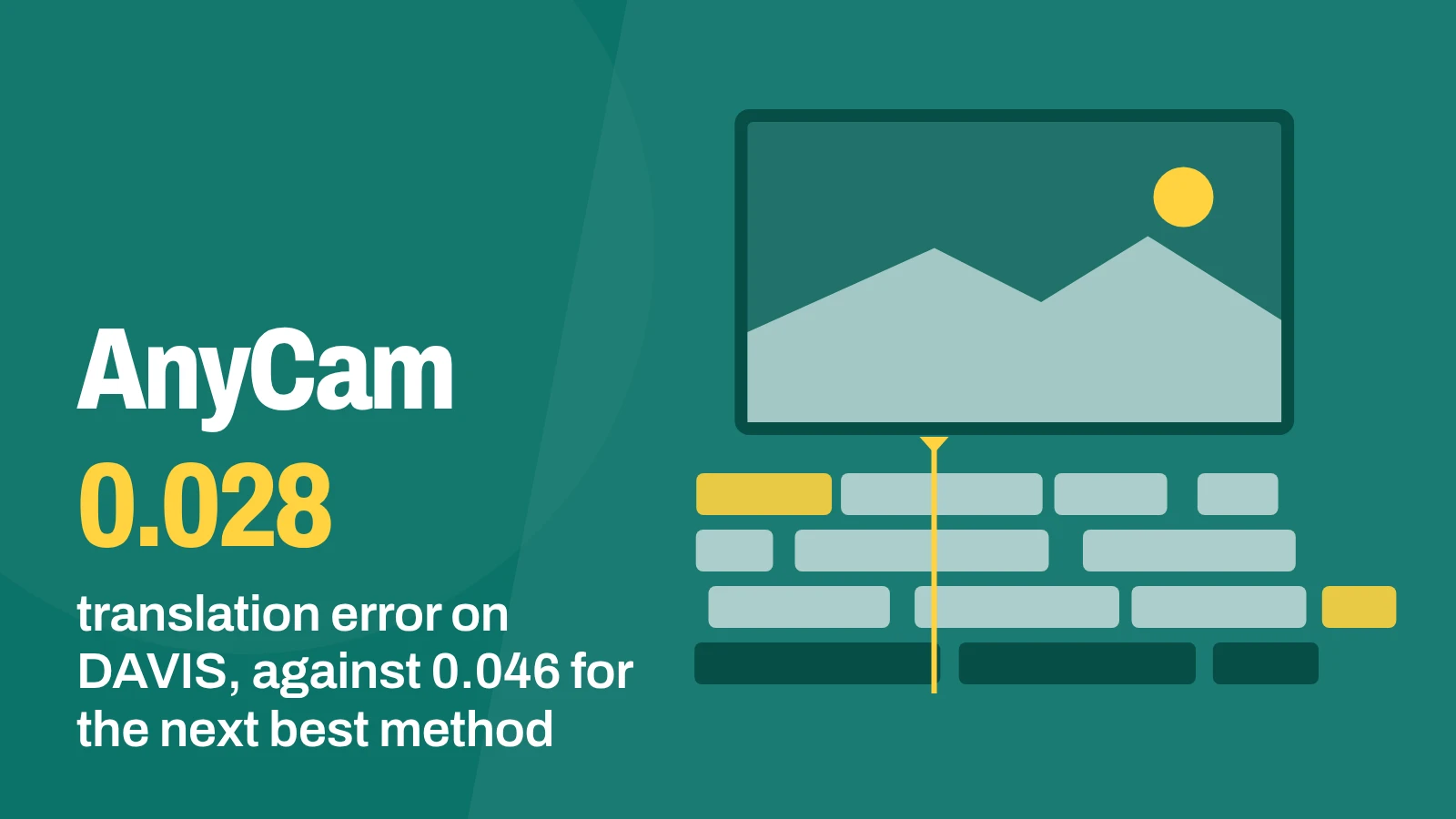
On DAVIS, AnyCam, a camera-control model for video generation described in an arXiv paper, reaches a translation error of 0.028, against 0.046 for the next best method (arXiv). The paper also presents a streaming variant, AnyCam-AR, and its long-video CO3D table puts that variant ahead of three baselines on all four measures shown here. For a team considering the code for orbit-style shots, the GitHub repository has no licence file, which bears on any reuse (GitHub).
A bidirectional model and a streaming distillation
According to the paper, inference with the bidirectional AnyCam model uses 50 sampling steps and text guidance of scale 5, and it produces videos of 81 frames at 832× 480. AnyCam-AR is the streaming counterpart: the authors describe it as built on the bidirectional model and trained with LoRA of rank 128, using chunks of 3 latent frames. The split gives two different jobs: the bidirectional model renders a fixed clip, while the autoregressive one emits chunks as it goes, which is what long and interactive camera paths need.
DAVIS: 0.028 translation error against 0.046
On DAVIS, the paper says the bidirectional AnyCam has the lowest translation error, 0.028 against 0.046 for the next best method. The figure belongs to the bidirectional model, not to AnyCam-AR, so it should not be carried over to the streaming variant. It is the authors’ own number, reported in their comparison table.
Long CO3D videos: AnyCam-AR against three baselines
In the table below, each row gives “Table block”, “Method”, “Ground Truth: PSNR ↑”, “Ground Truth: SSIM ↑”, “Ground Truth: LPIPS ↓”, “Ground Truth: oPSNR ↑”, “Source page”.
| Table block | Method | Ground Truth: PSNR ↑ | Ground Truth: SSIM ↑ | Ground Truth: LPIPS ↓ | Ground Truth: oPSNR ↑ |
|---|---|---|---|---|---|
| 165 frames, all frames | HY-WorldPlay | 11.23 | 0.371 | 0.689 | 9.51 |
| 165 frames, all frames | InSpatio-World | 11.98 | 0.448 | 0.634 | 10.74 |
| 165 frames, all frames | Wan-Fun-Cam-AR † | 12.70 | 0.464 | 0.631 | 10.72 |
| 165 frames, all frames | AnyCam-AR | 14.34 | 0.516 | 0.506 | 14.37 |
| 165 frames, unseen views | HY-WorldPlay | 10.92 | 0.364 | 0.708 | 9.16 |
| 165 frames, unseen views | InSpatio-World | 11.56 | 0.440 | 0.657 | 10.37 |
| 165 frames, unseen views | Wan-Fun-Cam-AR † | 12.48 | 0.459 | 0.646 | 10.46 |
| 165 frames, unseen views | AnyCam-AR | 13.99 | 0.512 | 0.523 | 14.11 |
| 249 frames, all frames | HY-WorldPlay | 11.08 | 0.344 | 0.699 | 9.50 |
| 249 frames, all frames | InSpatio-World | 12.00 | 0.445 | 0.637 | 10.73 |
The paper’s Table 8 covers 30 CO3D sequences, where an 81-frame source clip is played forward and backward and the target follows the real cameras around the object for 165 or 249 frames, or for 333 frames in total. In the 165-frame block over all frames, AnyCam-AR scores a PSNR of 14.34 and an LPIPS of 0.506, while InSpatio-World scores 11.98 and 0.634. The gap in PSNR over HY-WorldPlay, at 11.23, is larger still, and Wan-Fun-Cam-AR † sits at 12.70. On the unseen views of the same 165-frame setting, AnyCam-AR keeps a PSNR of 13.99 and an LPIPS of 0.523, a small drop from its all-frame values. Unseen views are ground-truth frames whose camera is at least 45° in azimuth from the arc the source clip covers, meaning sides of the object the input never shows. The oPSNR column, scored inside the object mask, shows the same ordering: 14.37 for AnyCam-AR against 10.74 for InSpatio-World and 9.51 for HY-WorldPlay in the 165-frame all-frames block. In the 249-frame block, HY-WorldPlay reaches 11.08 PSNR and InSpatio-World 12.00, close to their 165-frame values.
Throughput on four GPUs, and a repository without a licence
For streaming use, the authors say that running the stages of AnyCam-AR as a pipeline on four GPUs raises throughput to 11.2 FPS with identical outputs, while the first chunk still appears after 2.4 s. Someone planning interactive camera control would therefore budget four GPUs for that rate and expect a delay of 2.4 s before the first chunk. On a rotation-error comparison on RealEstate10K, the paper states AnyCam-AR’s error is less than half that of InSpatio-World.
The paper’s authors note that AnyCam could be used to create misleading content and say generated videos should be marked as such. Meanwhile the GitHub repository weijielyu/AnyCam has no licence file. Next to the authors’ call for marking generated videos, the repository’s missing licence file means it states no reuse terms for the code.
Related coverage: VivaWorld paper reports 23.4% and 38.8% lower long-video camera errors than Lyra2.
Follow and ask
Add to Preferred Sources on Google
Summarise with AI:ChatGPTClaudePerplexityGoogle AI
How we built this
Published resultsTable 8 of the paper: Long videos on CO3D, all metrics
Rows of Table 8 of the paper (arXiv HTML version), copied cell for cell by our code; a two-row header is shown as "group: column". These are the authors' own figures, not an independent test. The first column is the block of the table the row sits in. The table has 9 columns; 5 shown. Not shown: Ground Truth: 2 more columns, Anchor (2 columns). Rows: the first 10 of 28. Of its 7 blocks, not shown: 249 frames, unseen views (4 rows), 333 frames, all frames (4 rows), 333 frames, unseen views (4 rows), 333 frames, way back (4 rows); shown in part: 249 frames, all frames (2 of 4 rows).
Sources
The sources this article was written from. Links open the original page.