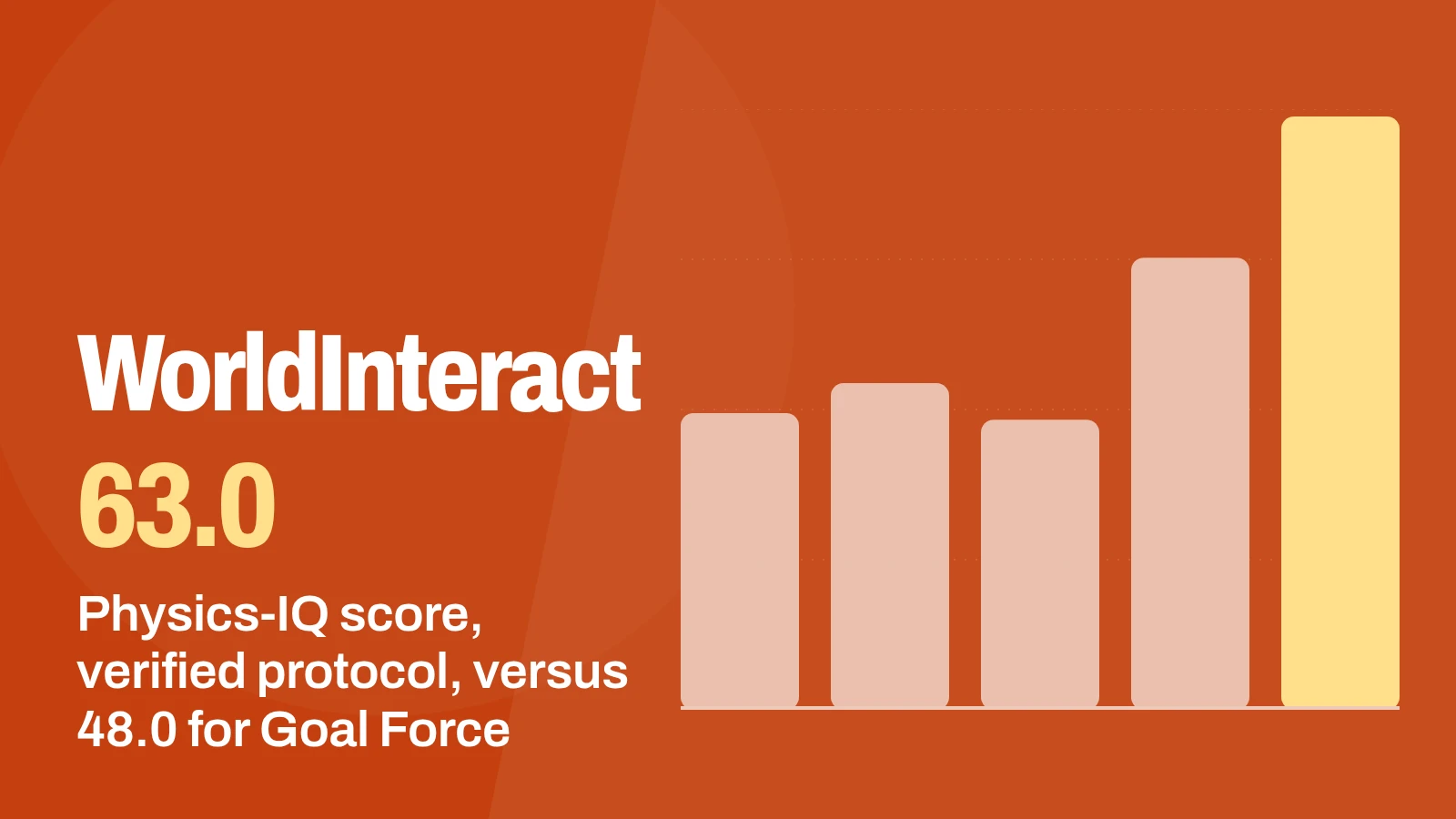
The authors of WorldInteract, a streaming video generation framework described in an arXiv paper, report a Physics-IQ score of 63.0 (verified protocol) and 68.2 (original protocol), against 48.0 and 52.9 for the strongest baseline, Goal Force, plus 90% push success on real-world images (arXiv). They say the method substantially outperforms state-of-the-art methods on Physics-IQ and gives more reliable push control on real-world images (arXiv). For someone choosing a model to move an object at a specified moment, the figure to check is the spatiotemporal IoU of 0.701, not the overall score alone.
Two jobs for one model: behavior and contact
The paper splits cross-material interaction into two parts: generating behavior that depends on the material, and computing the response when objects touch. The video model underneath starts from Wan2.2-TI2V-5B, to which the authors add a zero-initialized patch embedding for push control. They then fine-tune the diffusion transformer on 49-frame clips with full attention. For interactive use, they distill a four-step causal student, and they say this distilled model streams at 8 fps on a single H100.
The 8 fps figure belongs to the distilled student, not to the fine-tuned model trained on 49-frame clips, so anyone budgeting a live demo on one H100 should plan around the student.
Physics-IQ: 63.0 against 48.0, with the gain in timing
In the table below, each row gives “Method”, “P-IQ ↑: Verified”, “P-IQ ↑: Original”, “IoU ↑: ST”, “IoU ↑: S”, “IoU ↑: WS”, “Source page”.
| Method | P-IQ ↑: Verified | P-IQ ↑: Original | IoU ↑: ST | IoU ↑: S | IoU ↑: WS |
|---|---|---|---|---|---|
| Wan2.2 (text-guided) | 31.5 | 24.6 | 0.338 | 0.308 | 0.264 |
| Force Prompting | 34.7 | 30.4 | 0.095 | 0.533 | 0.395 |
| StreamForce | 30.8 | 25.4 | 0.071 | 0.474 | 0.372 |
| Goal Force | 48.0 | 52.9 | 0.280 | 0.745 | 0.475 |
| WorldInteract | 63.0 | 68.2 | 0.701 | 0.779 | 0.607 |
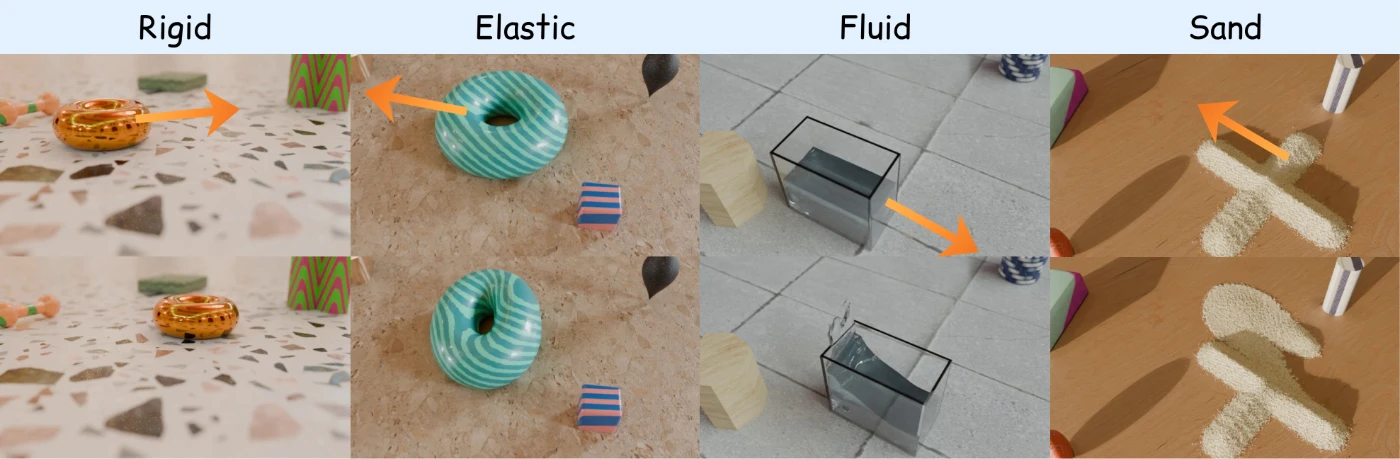
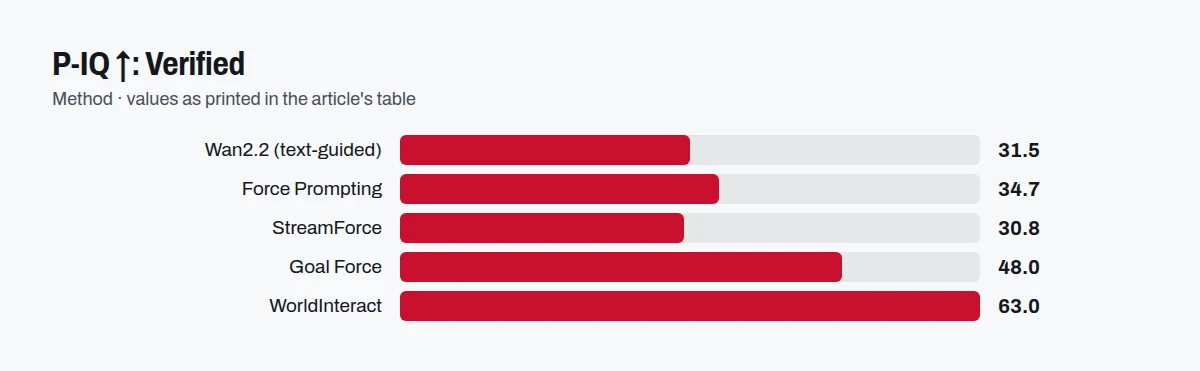
On Physics-IQ, WorldInteract scores 63.0 under the verified protocol and 68.2 under the original one; Goal Force, the strongest baseline, scores 48.0 and 52.9. The paper puts the lead at 15 points and notes that Goal Force uses a much larger backbone. On spatiotemporal IoU, which checks when motion happens, the authors say WorldInteract scores more than twice as high as any baseline. On spatial IoU, which checks only where motion happens, they say Goal Force is close to their model.
The table bears that out: on spatiotemporal IoU WorldInteract has 0.701 against 0.280 for Goal Force and 0.338 for text-guided Wan2.2, while on spatial IoU the two top rows are 0.779 and 0.745. So the Physics-IQ gap comes mostly from when objects move, not where they end up. Force Prompting and StreamForce, at 0.095 and 0.071 on spatiotemporal IoU, show the weakest timing of the five rows, despite spatial IoU of 0.533 and 0.474. Because the table comes from the paper itself, the ranking awaits independent testing.
Real-image pushes: 67% to 90%, and the trade-offs of rivals
On real-world images, the paper says WorldInteract raises push success from 67%, reached by StreamForce as the strongest baseline, to 90%. Among the baselines, Wan2.2 scores well on SA yet moves the object in just 30% of pushes, while Force Prompting scores well on PC but has the lowest SA.
For a team that needs an object to actually move when pushed, the 30% for Wan2.2 is the number that rules out prompt-only control, and the 90% is the bar a push-control method has to meet.
Approximate geometry and frictionless collisions
The authors state that the current controller uses approximate geometry and a frictionless central collision model. The contact response is therefore simplified, and the Physics-IQ and push-success results hold for a controller built on those assumptions. A user whose scenes depend on friction or off-center impacts would need to check the model on those cases before relying on the reported scores.
Choosing between WorldInteract and Goal Force for timing-sensitive pushes, the spatiotemporal IoU of 0.701 against 0.280 is the most relevant gap, while for placement alone the 0.779 against 0.745 spatial IoU shows little difference.
Related coverage: AnyCam paper reports the lowest DAVIS translation error and a streaming variant for long CO3D videos.
Follow and ask
Add to Preferred Sources on Google
Summarise with AI:ChatGPTClaudePerplexityGoogle AI
How we built this
Published resultsTable 1 of the paper: Physics-IQ evaluation
Rows of Table 1 of the paper (arXiv HTML version), copied cell for cell by our code; a two-row header is shown as "group: column"; an empty name cell repeats the name above it. These are the authors' own figures, not an independent test.
Sources
The sources this article was written from. Links open the original page.