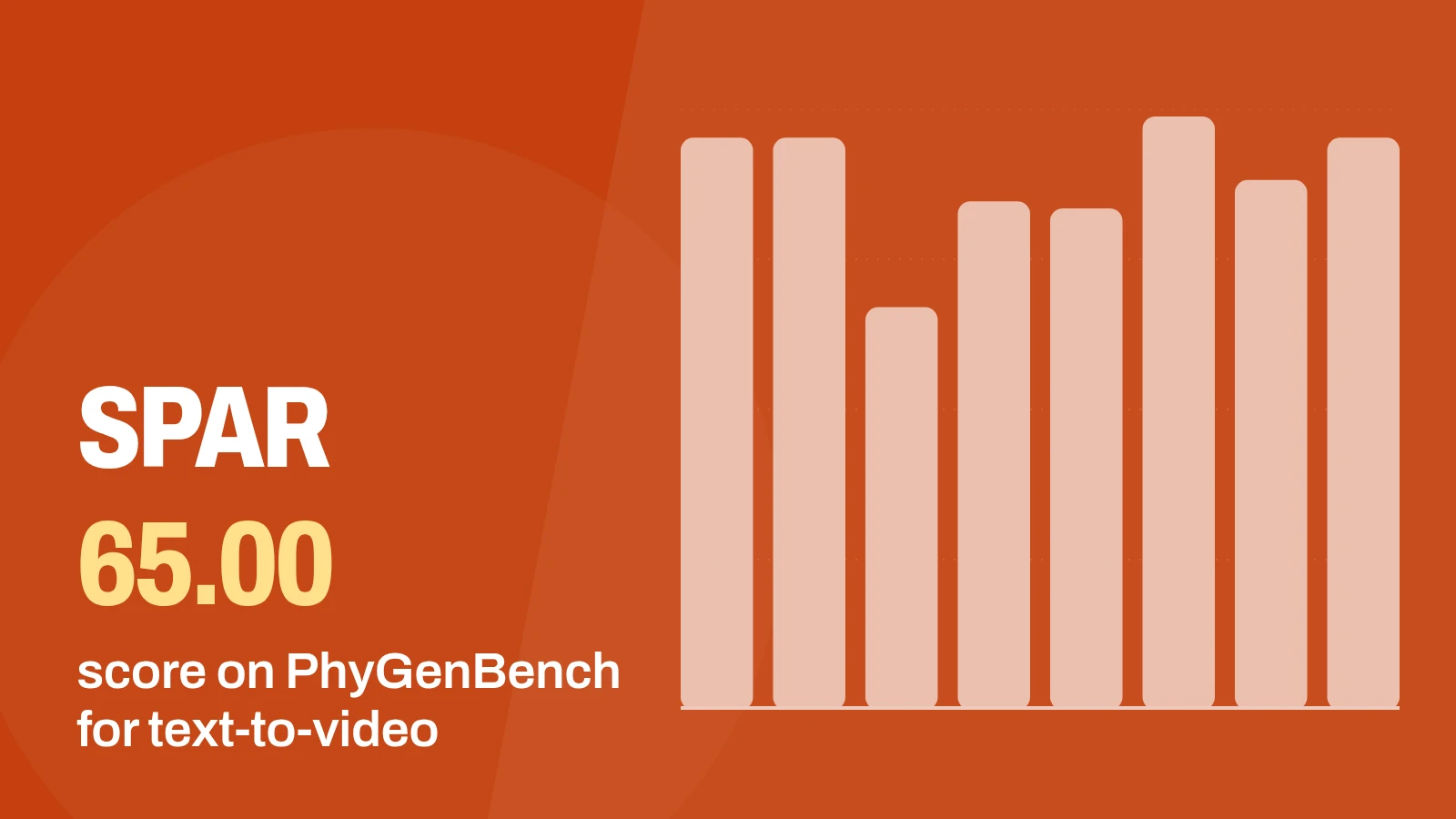
SPAR, a method for physical alignment in video generation described on arXiv, reaches 65.00 on PhyGenBench and 62.78% on VideoPhy-2 Hard for text-to-video, according to its paper (arXiv). The paper says it improves physical plausibility for both text-to-video generation and image-to-video continuation (arXiv). For someone who already samples several clips per prompt, it is a way to choose which one to keep, at the price of generating the extra candidates.
A static copy of each clip as the yardstick
SPAR is described as an inference-time framework: it does not change the generator, it scores finished videos. For each video, it compares the prediction error of a world model with the error on static clips built by repeating that video’s own frames. According to the authors, this gives a reference matched to the content, so the score reflects the generated motion rather than the scene itself.
The design differs from a reward that looks only at the raw error of a clip, because a busy scene and a plain one are each judged against their own frozen version. The paper also reports an ablation called SPAR-base, which selects candidates using only the difference between the static-reference and real-video mean prediction errors.
Selection among three MiniMax-H3 candidates
In the paper’s best-of-N setup with N=3, the same three MiniMax-H3 candidates per input are used for every selection method. That pool holds 1,614 videos across 538 inputs. Because every method picks from identical candidates, differences between rows come from the selector and not from a different generator.
In a human evaluation, SPAR receives the highest mean on both criteria, scoring 4.083 for physical plausibility and 4.317 for event completion.
Against WMReward and the generator baselines on Table 1 (b)
In the table below, each row gives “Method”, “Chem.”, “Force”, “Heat”, “Light”, “Phys.”, “Source page”.
| Method | Chem. | Force | Heat | Light | Phys. |
|---|---|---|---|---|---|
| Wan2.2-TI2V-5B | 60.00 | 65.00 | 61.11 | 70.00 | 54.67 |
| CogVideoX1.5-5B | 60.00 | 57.50 | 64.44 | 66.00 | 52.00 |
| Cosmos3-Nano | 42.22 | 59.17 | 50.00 | 66.67 | 48.00 |
| HunyuanVideo-1.5 | 53.33 | 65.83 | 57.78 | 79.33 | 56.00 |
| MiniMax-H3 | 52.59 | 58.89 | 56.67 | 74.67 | 54.22 |
| GeoPhys | 62.22 | 61.67 | 54.44 | 76.00 | 54.67 |
| WMReward | 55.56 | 60.00 | 50.00 | 74.67 | 57.33 |
| SPAR (ours) | 60.00 | 63.33 | 58.89 | 74.67 | 58.67 |
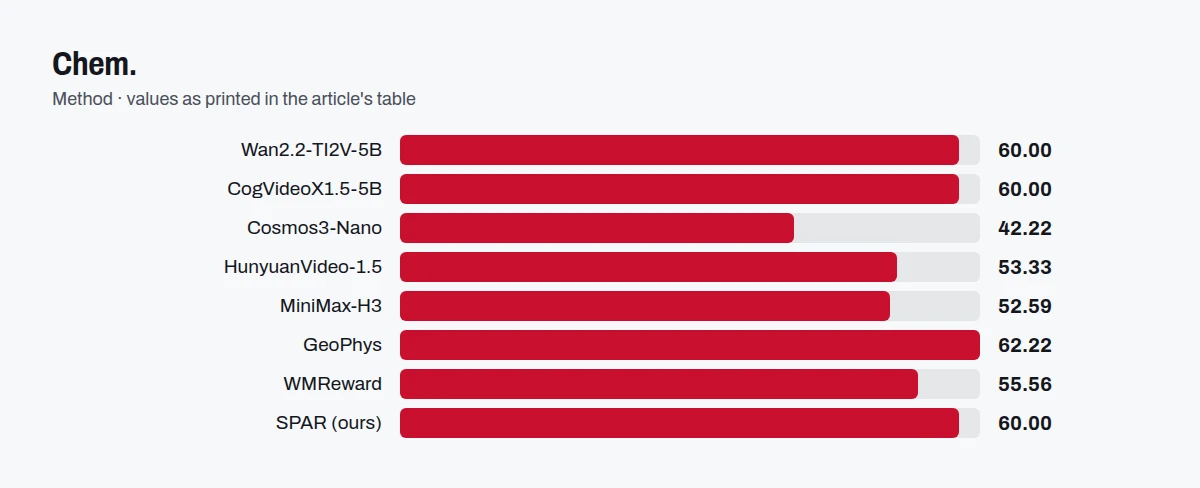
SPAR scores 63.33 on Force and 58.67 on Phys., against 60.00 and 57.33 for WMReward. On Heat, SPAR reaches 58.89 while WMReward sits at 50.00. On Light the two are level at 74.67, and HunyuanVideo-1.5 is higher at 79.33. On Chem., GeoPhys scores 62.22 and Wan2.2-TI2V-5B and CogVideoX1.5-5B score 60.00, the same as SPAR. SPAR therefore does not lead every column: its advantage over WMReward is clearest on Heat, and on Light another model scores higher.
Where selection cannot help
The authors state that SPAR works by candidate selection, so its gains depend on the quality and diversity of the candidates. It cannot correct physical errors shared by all candidates.
For a team choosing between sampling more candidates and switching generators, this matters: if all three clips from a prompt break the same law, a better selector will return one of the broken ones. A pipeline that already generates three clips per input, as in the MiniMax-H3 setup of 538 inputs, can add this scoring step without touching the generator, but its benefit is bounded by what those clips contain. Since the table is the authors’ own and the strongest margins sit in single categories such as Heat, a team would do better to check the category closest to its own content before expecting the headline gain.
Not in the sources: price
We check six facts on every story in the full text of each source. The pages listed under Sources do not state a price.
Related coverage: Lyris, a layout-planned video model, cuts camera error 3.8x on minute-long round trips, authors say.
Follow and ask
Add to Preferred Sources on Google
Summarise with AI:ChatGPTClaudePerplexityGoogle AI
How we built this
Published resultsTable 1 (b) of the paper: Overall results
Rows of Table 1 (b) of the paper (arXiv HTML version), copied cell for cell by our code; a two-row header is shown as "group: column"; an empty name cell repeats the name above it. These are the authors' own figures, not an independent test. The table has 7 columns; 6 shown. Not shown: Overall.
Sources
The sources this article was written from. Links open the original page.
- arXivSPAR: Self-Referenced World-Model Rewards for Physical Alignment in Video Generationarxiv.org
- arXivSPAR: Self-Referenced World-Model Rewards for Physical Alignment in Video Generationarxiv.org
- gavin-jy.github.iohttps://gavin-jy.github.io/spar-page/: page linked by the paper as its resourcegavin-jy.github.io