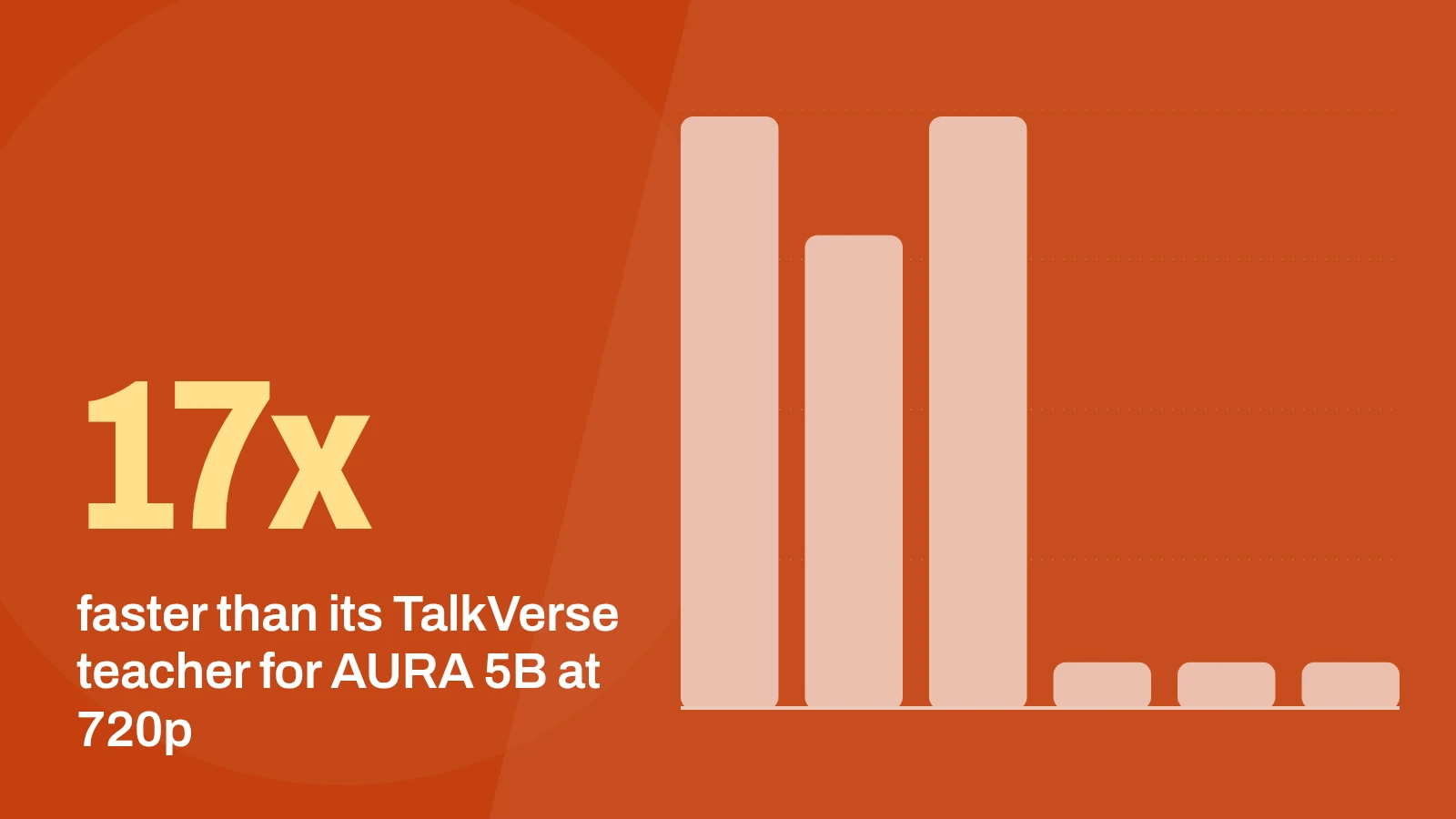
In an arXiv paper on AURA, an audio-driven streaming avatar model, AURA 5B is reported to match its TalkVerse teacher at 720p while running 17x faster, and AURA 1.3B runs 23x faster than its own bidirectional teacher with quality comparable to TalkVerse at a lower resolution (arXiv). For anyone building a live conversational avatar, the paper presents a demo that couples AURA 1.3B with the Unmute voice assistant on a single H100 GPU, while the Live Avatar baseline needs a 5-GPU setup (arXiv).
From a 50-step teacher to a 4-step causal student
The authors train a causal student from a bidirectional teacher in two stages. The first stage aligns the student with the teacher’s trajectories using fewer diffusion steps and a chunk-wise sliding-window causal attention mask, and the second applies Distribution Matching Distillation. The paper says the result uses 4 denoising steps instead of 50, yet matches or improves on the TalkVerse teacher across most automatic metrics. It also calls the output comparable to the much larger Wan-S2V, a 14B multi-step model, on quality and audio-visual alignment.
On training cost, AURA 5B ran Stage 1 for 120K steps and Stage 2 for 5K steps, on 64 H100 GPUs. That is a cluster-scale job, so the single-GPU claim applies to inference, not to reproducing the training.
Throughput against four baselines on Hallo3
| Method | Params | Res | Steps | DiT / VAE (fps) ↑ | Total (fps) ↑ |
|---|---|---|---|---|---|
| Hallo3 | 14.5B | 480p | 50 | 0.24/3.2 | 0.22 |
| Wan-S2V | 14B | 720p | 40 | 0.08/6.7 | 0.08 |
| TalkVerse | 5B | 720p | 50 | 0.69/7.4 | 0.58 |
| Live Avatar | 14B | 480p | 4 | 8.4/4.3 | 1.9 |
| AURA 5B (ours) | 5B | 720p | 4 | 19.7/22.7 | 9.7 |
| AURA 1.3B (ours) | 1.3B | 480p | 4 | 28.8/96.9 | 20.7 |
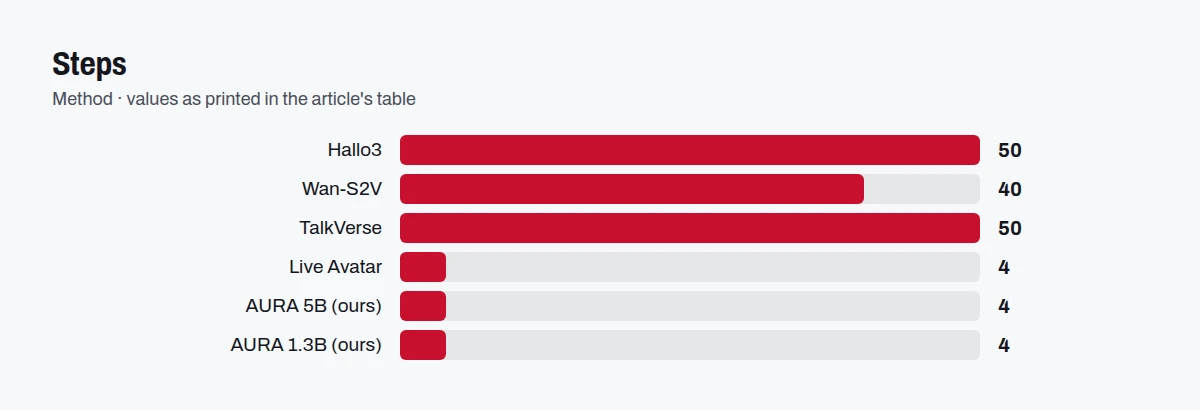
The paper’s Table 1 lists parameters, resolution, steps and throughput for each method, measured in frames per second on a single H100. Its end-to-end figure includes model offload and overhead, while the DiT/VAE pair covers only the diffusion transformer and the VAE decoder. AURA 5B reaches 9.7 fps end to end, against 0.58 fps for its TalkVerse teacher, which the authors describe as a speedup of about 17x. Among the rows, Live Avatar is the closest few-step rival at 4 steps, with an end-to-end figure of 1.9 fps. Both AURA rows sit well above every baseline end to end: 9.7 fps for AURA 5B and 20.7 fps for AURA 1.3B, versus 0.22 fps for Hallo3 and 0.08 fps for Wan-S2V. The gap between DiT/VAE and total figures also shows that overhead matters: AURA 5B drops from 19.7 on the transformer to 9.7 overall.
Real time depends on the playback rate and the resolution
The abstract says AURA 1.3B streams 576p video in real time on one GPU at 20.7 fps, for a 16 Hz playback rate. The Table 1 caption, however, says AURA 1.3B outputs 480p at 16 Hz, like Wan-S2V and Live Avatar, and that the other AURA and TalkVerse rows run at 25 Hz. The abstract also says AURA 5B streams 720p video at 9.7 fps. Set against the 25 Hz rate the caption gives for that row, 9.7 fps is a throughput figure, and the 20.7 fps of the 1.3B model is the one that clears its stated playback rate. The ablations use the 5B student on the Hallo3 test set with 10 s clips, so the reported quality holds for short clips on that benchmark. The authors attribute low identity drift over long generations to their RoPE indexing and to keeping the first generated chunks in the rolling cache.
Choosing between the 1.3B and 5B students
The authors describe a live demo that couples AURA 1.3B with Unmute, in which users hold a spoken conversation with a synthetic avatar in real time on a single H100 GPU. For a team picking a size for such an interactive product, the table gives the trade: AURA 1.3B at 480p and 20.7 fps total, or AURA 5B at 720p and 9.7 fps total. Anyone who currently runs Live Avatar, a 14B model at 16 fps and 480p on 5 GPUs, would compare it with AURA 1.3B at the same 480p on one H100 in the table. All figures are the authors’ own, measured on one hardware type, so a deployment on other GPUs would need its own measurement.
Related coverage: Motion-aware reward model cuts motion-suppressed edit picks to 0%, authors report.
Follow and ask
Add to Preferred Sources on Google
Summarise with AI:ChatGPTClaudePerplexityGoogle AI
How we built this
Published resultsTable 1 of the paper: Main results on Hallo3 test
Rows of Table 1 of the paper (arXiv HTML version), copied cell for cell by our code; a two-row header is shown as "group: column"; an empty name cell repeats the name above it. These are the authors' own figures, not an independent test. The table has 13 columns; 6 shown. Not shown: FID ↓, FVD ↓, JEDi ↓, CSIM ↑, Sync-C ↑, Sync-D ↓, WE ↓.
Sources
The sources this article was written from. Links open the original page.