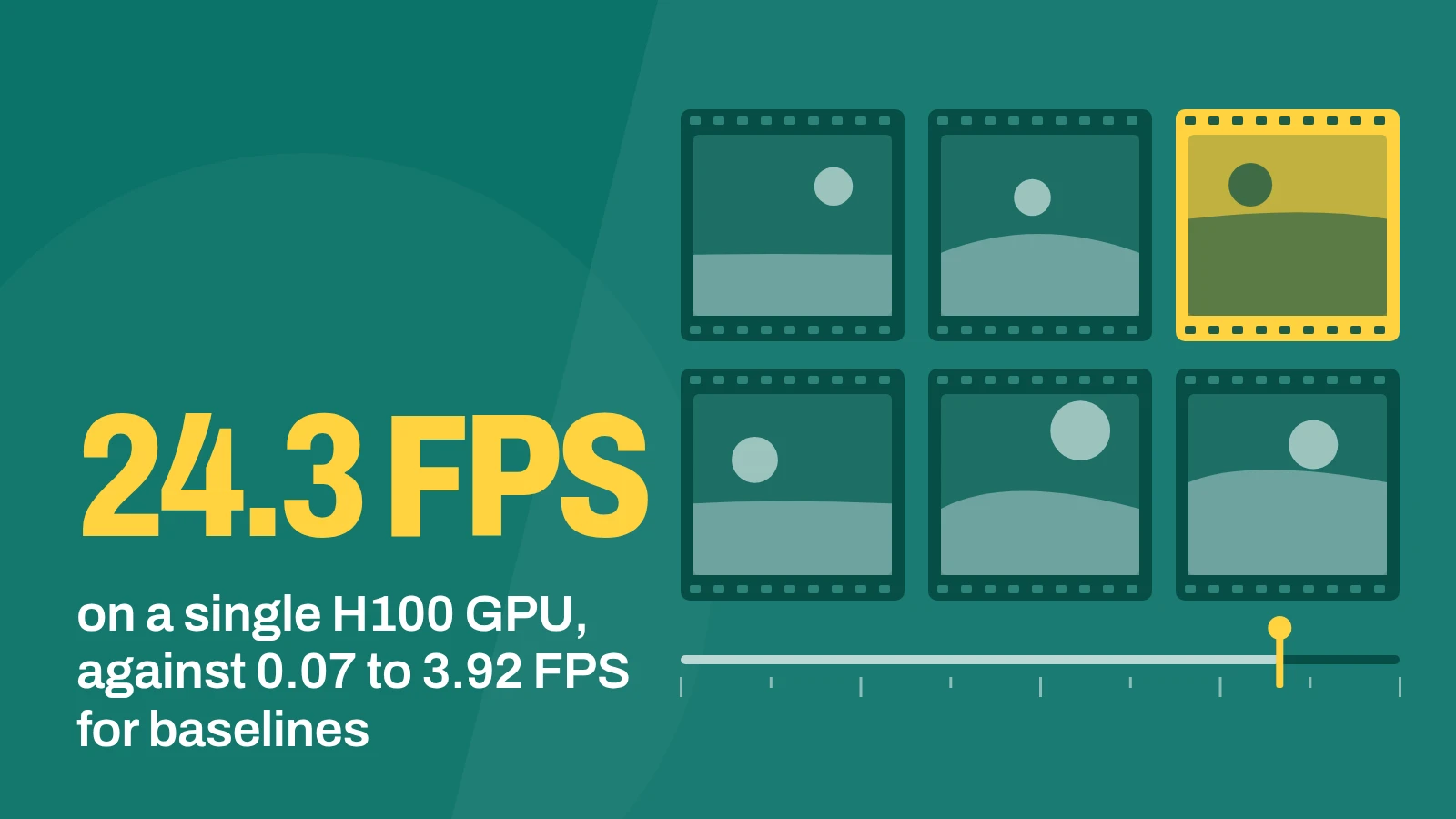
The StreamEgo authors report in an arXiv paper that their distilled, chunk-wise autoregressive model generates egocentric video from exocentric streams at 24.3 FPS on a single H100 GPU (arXiv). In the paper’s Table 1, the five fine-tuned baselines run between 0.07 and 3.92 FPS on the New Action split (arXiv). For a team that wants a live first-person view from a fixed third-person camera, that is the difference between a feed it can stream and clips it must render offline.
Why a 50-step teacher cannot stream
The authors start from a bidirectional teacher model that needs 50 steps and runs at 0.97 fps. At that rate a single chunk would take roughly 34 s, and the paper says no amount of pipelining could hide it. That arithmetic is why the paper says few-step distillation is necessary: the 50-step teacher is far too slow for a live feed, so the student is distilled to 3 steps.
According to the paper, the streaming pipeline introduces an end-to-end latency of exactly two chunks. The delay is therefore fixed by the chunk size rather than by the length of the clip being generated.
Speed of the student against five fine-tuned baselines
In the table below, each row gives “”, “Method”, “Efficiency: FPS ↑”, “Source page”.
| Method | Efficiency: FPS ↑ | |
|---|---|---|
| New Action (new actions, seen envs.) | Exo2Ego-V | 3.92 |
| New Action (new actions, seen envs.) | TrajCrafter | 0.30 |
| New Action (new actions, seen envs.) | Wan-VACE | 0.96 |
| New Action (new actions, seen envs.) | Vista4D | 0.07 |
| New Action (new actions, seen envs.) | EgoX | 0.08 |
| New Action (new actions, seen envs.) | Ours (teacher) | 0.97 |
| New Action (new actions, seen envs.) | Ours (student) | 24.3 |
| New Action (new actions, seen envs.) | Ours (long) | 24.3 |
| New Action (new actions, seen envs.) | Ours (est.) | 24.3 |
| Unseen (new actions, new envs.) | Exo2Ego-V | 3.92 |
On the New Action split, Exo2Ego-V reaches 3.92 FPS, Wan-VACE 0.96, TrajCrafter 0.30, EgoX 0.08 and Vista4D 0.07. The authors’ own teacher is listed at 0.97 FPS, while the student, the long-rollout variant and the variant fed with estimated trajectories are each listed at 24.3. Even the fastest baseline, Exo2Ego-V at 3.92, stays far below the student’s 24.3, and the long and estimated-pose variants keep that speed.
All baselines were fine-tuned on the authors’ training dataset, which the paper presents as a fair comparison. Other related works were left out because they are not open-source. The comparison therefore covers only methods the authors could retrain themselves.
Estimated poses, seeds and where the result stops
The student’s egocentric trajectory can be estimated from the exocentric video instead of taken from the dataset, a setting the paper calls Ours (est.). Measured against the dataset trajectories, the estimated poses are off by 52.8 cm and 22.3° on New Action, 54.5 cm and 22.7° on Unseen, and 6.3 cm and 10.9° on H2O. The authors attribute the large Ego-Exo4D position error mostly to the viewing ray, since wearers stand about 3 m from the camera, against about 1 m on H2O. They say StreamEgo remains competitive with the baselines, which all use ground-truth trajectories.
The authors re-ran their models with five additional random seeds and say the ranking in Table 1 holds, because the standard deviation is small compared with their margins over the baselines. In the user study, the streaming student scored an average of 4.6/5.0 on extended rollouts. The result therefore holds best where the camera is close to the wearer and the trajectory is accurate; with a distant camera the pose estimate degrades and quality rests on a looser guarantee.
Budgeting hardware and tracking for a live deployment
The paper adds that dedicated hardware trackers, such as on-device SLAM or inertial sensors, could further improve pose accuracy and thus generation quality. A deployment with a camera about 3 m away and no tracker should expect the pose errors reported for estimated trajectories, whereas the 6.3 cm figure on H2O reflects a camera about 1 m away.
Related coverage: Video API audit: only signed provenance backs tier claims, authors say.
Follow and ask
Add to Preferred Sources on Google
Summarise with AI:ChatGPTClaudePerplexityGoogle AI
How we built this
Published resultsTable 1 of the paper: Comparison on the New Action and Unseen from Ego-Exo4D and H2O
Rows of Table 1 of the paper (arXiv HTML version), copied cell for cell by our code; a two-row header is shown as "group: column"; an empty name cell repeats the name above it. These are the authors' own figures, not an independent test. The table has 16 columns; 3 shown: the Efficiency columns, the ones the paper's text citing the table reports on. Not shown: Image Metrics (8 columns), Object Metrics (2 columns), Video Metrics (3 columns). Rows: the first 10 of 27. Of its 3 blocks, not shown: (in-the-wild.) (9 rows); shown in part: Unseen (new actions, new envs.) (1 of 9 rows).
Sources
The sources this article was written from. Links open the original page.